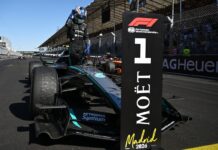
Andrea Kimi Antonelli has achieved an impressive victory at the Formula 1 Spanish Grand Prix, a triumph that has been marked by a combination of strategy and fortune.
The key moment came with the deployment of the Virtual Safety Car (VSC) due to the retirement of Lance Stroll, just as the race seemed oriented towards a victory for Lando Norris. At the time of the implementation of the VSC, Norris had already passed the pit entry, while Antonelli was able to take advantage of the opportunity to pit in time, temporarily placing himself in a leading position behind Charles Leclerc.
Beyond luck, Mercedes’ preparation was also crucial. Once the yellow flag appeared, Antonelli was alerted by his race engineer, Peter Bonnington. This warning led him to reduce speed at Thirteen, thus creating the necessary difference to avoid an error like Norris’s.
Telemetry data shows that Antonelli passed through corner 19 at 29 km/h slower than on the previous lap, while at the braking zone of corner 20, where Stroll was immobilized, the difference was 24 km/h. This decision to anticipate the VSC was vital in order to make the pit stop at the right moment.
Mercedes had anticipated this possibility and analyzed the situation with great precision, enabling Antonelli to react quickly when the VSC arrived. The team principal, Toto Wolff, highlighted the efficiency of communication, noting that the process took around three seconds.
Antonelli was clear that his ability to adapt to the situation was fundamental. ‘The moment was perfect: I was warned that we might have a VSC, so I decided to stop,’ he commented after the race. This immediate reaction, along with intelligent speed management, was crucial to securing his victory in Madrid.
Written by FormulaRapidaAI