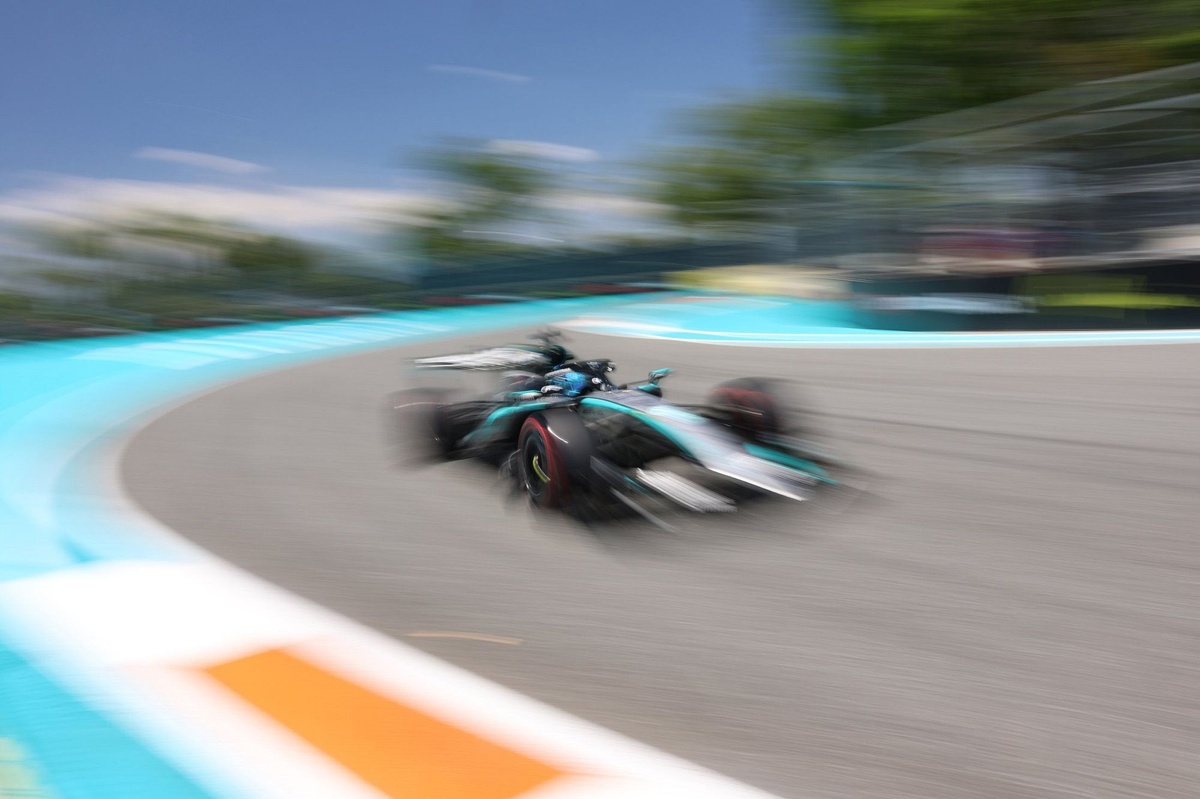
The Miami Grand Prix has been the setting for an extended 90-minute practice session, allowing Formula 1 teams to conduct long runs to adapt to updates and regulatory changes. This circumstance has provided valuable data for analyzing the competitive order ahead of Sunday’s race.
Both Mercedes drivers have excelled on average in their long runs. Adjusting the data to account for stint lengths and tire compounds, championship leader Kimi Antonelli was the fastest at heavy weight, with just 0.03 seconds advantage over his teammate, George Russell. This reaffirms Mercedes’ dominant position at the front of the grid.
In second place, Charles Leclerc of Ferrari showed an average deficit of 0.33 seconds per lap, while Lewis Hamilton, also a Ferrari driver, finished fourth with a distance of 0.6 seconds per lap.
Rivals closing in on Mercedes
Although the overall hierarchy has not changed significantly, rivals seem to have closed the gap to Mercedes. In the early races of the season, Ferrari was 0.53 seconds per lap off, but recent data suggest an improvement of about two tenths.
McLaren has positioned itself as the third force in long runs, averaging 0.87 seconds slower than Mercedes. Its performance is also similar to Ferrari’s, losing time especially on the straights.
Red Bull shows signs of improvement
After implementing seven updates, Red Bull seemed to need a change, given that its RB22 had been one of the slowest compared to Mercedes. With the first signs of this improvement, Max Verstappen clocked a time only 0.88 seconds slower than Mercedes, representing an improvement of about four tenths compared to previous races.
After a strong second place in outright speed, Verstappen stood out in straight-line speed, hitting 333 km/h. However, the car still shows weakness in the corners, as observed in the first two sectors of the circuit.
The midfield debate
In the midfield area, Alpine and Haas have remained the most competitive teams. Franco Colapinto was the fastest in this section with a time of +1.32s. Other drivers like Esteban Ocon and Oliver Bearman from Haas followed closely.
The situation has not been favorable for Aston Martin, which did not complete long runs, while the Racing Bulls drivers have not shown a good race pace.
Strategic tire decisions
In the context of tire strategies, teams made limited use of the compounds, with only one set of hard tires and one set of softs for qualifying simulations. Red Bull, in particular, opted to use a set of medium tires, which they will not have available later in the weekend.
Tire degradation is unlikely to play a decisive role, as the race time for Sunday is unstable, and the Miami International Autodrome layout usually presents low tire wear.
Written by FormulaRapidaAI