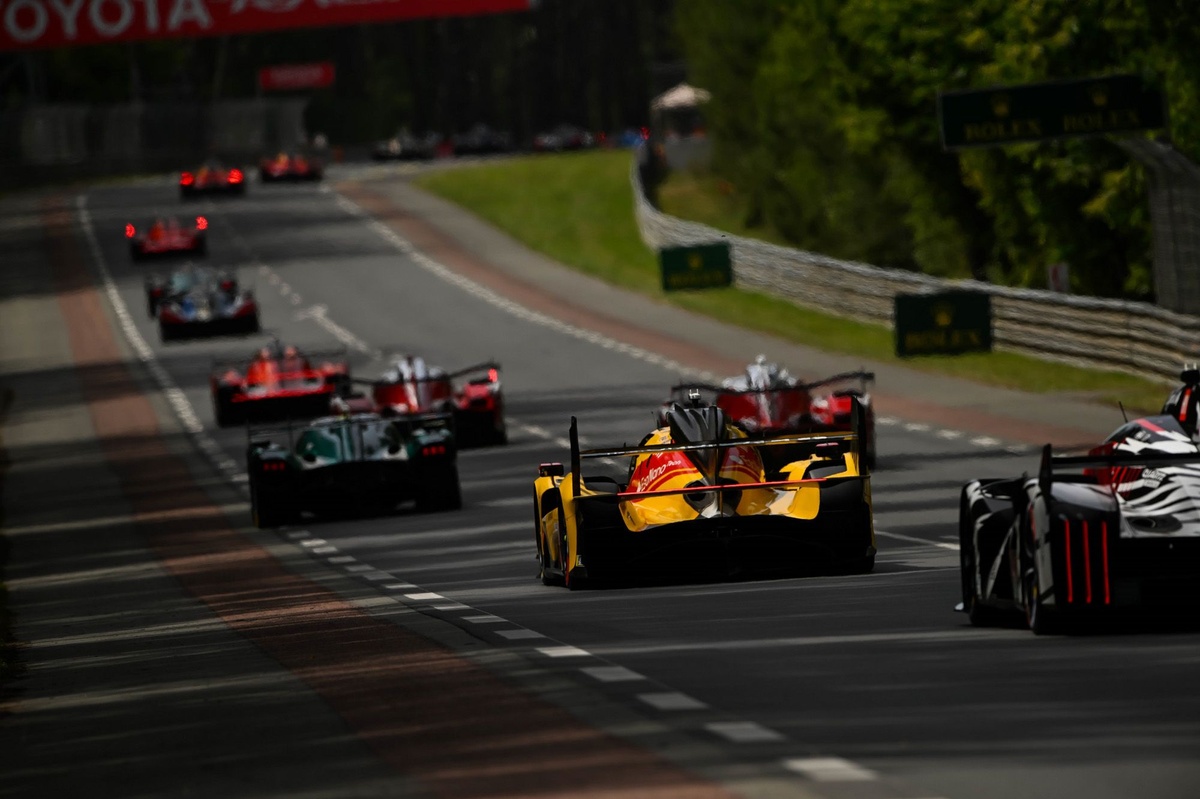
In an exciting edition of the 24 Hours of Le Mans, Toyota has achieved its sixth victory, demonstrating that it can compete at the highest level in the most prestigious motorsport race. However, data analysis reveals that its winning vehicle, the #7 Toyota TR010, was not the fastest on track during the competition.
Upon investigating the averages of the best 60% of laps from all vehicles, the #7 ranked fourth. Instead, it was its teammate, the #8 Toyota, who set the pace at all times. The lap times from the cars in this segment show that the fastest was the #8 with an impressive 3:28.059, followed by the Cadillac #12 with 3:28.294 and the BMW #20 with 3:28.377.
The main reason for the #7’s disadvantage was an unscheduled pit stop for a flat tire in the early stages of the race, which caused it to drop to mid-pack. Additionally, a rear sensor issue resulted in slower lap times during the competition.
The influence of safety cars
The intervention of safety cars played a fundamental role in the race’s outcome. The modifications to the 2023 rules have allowed races, including Le Mans, to resemble the 24 Hours of Daytona. Now, initial mistakes are no longer decisive, as a safety car can neutralize the advantages accumulated during the race.
In the final laps, the #8 Toyota, which had the highest speed at the beginning, was hindered by a penalty and unscheduled repairs. This gave the #7 Toyota a chance to remain in contention for victory.
The role of strategies in the final laps
Analyzing the 50 best laps following the restart after the safety car, the results largely coincide with the final race outcome. The #7 Toyota continued to lead with a time of 3:27.260, closely followed by the Cadillac #12 at 3:27.266, demonstrating the competitiveness among brands in the final laps.
The Cadillac #12, traditionally not known for its strength in high-temperature conditions, significantly improved after finishing laps on medium tires, achieving an impressive pace.
The fall of Alpine and other surprises
Another highlighted aspect was the disappointing performance of Alpine, which many expected to fight for the podium. Instead, its performance deteriorated, and the car could not maintain a position among the top contenders. This situation allowed Ferrari to secure a good position, relegating Alpine to a secondary role.
Toyota’s victory marks an important milestone in its career, but the laws of competition have reinforced the idea that speed is not always the only thing that determines the winner in an endurance race like Le Mans. Strategic changes and external interventions have proven to be fundamental in defining the final outcome.
Written by FormulaRapidaAI