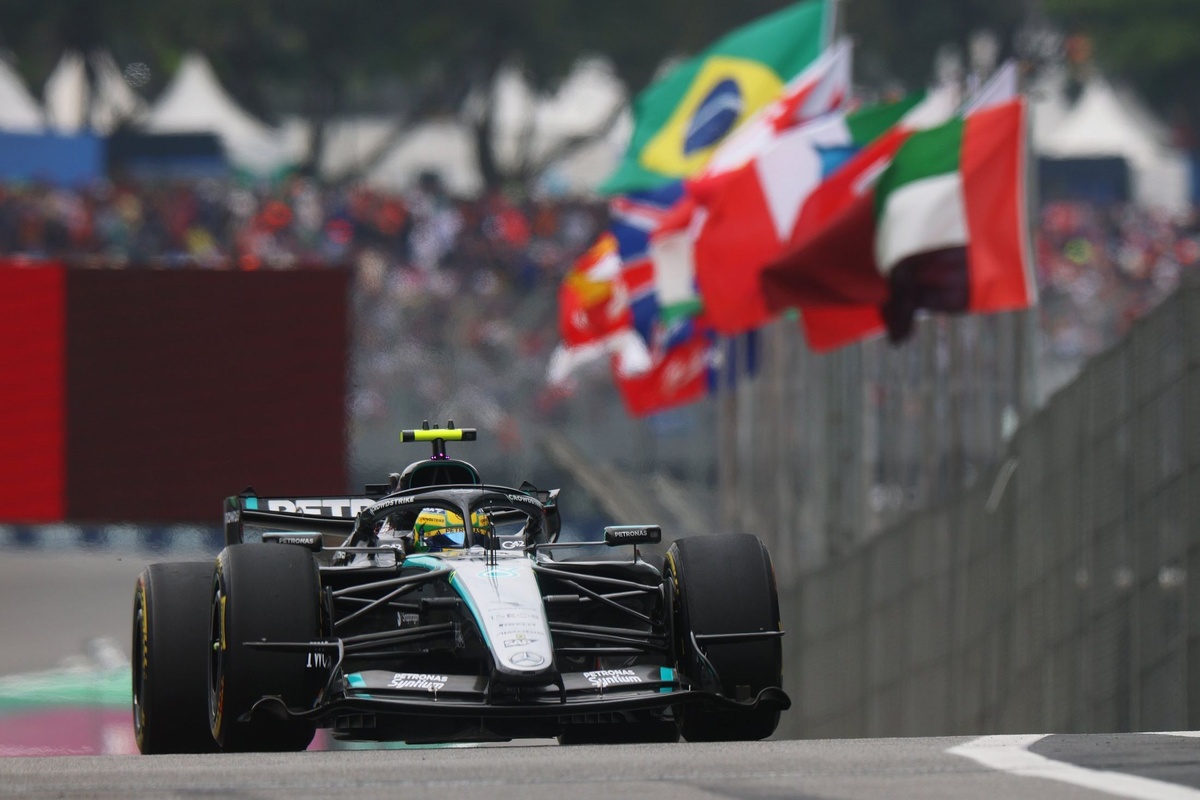
Driver Kimi Antonelli has become the benchmark during the Formula 1 weekend in São Paulo. The recent world champion was not only the fastest in the free practice session 2, but also showed excellent performance during the race simulations. This puts Mercedes in a favorable position to face the rest of the weekend, while Ferrari has experienced a complicated Friday.
In the qualifying simulations, Antonelli outpaced Lando Norris from McLaren by 0.253 seconds and Max Verstappen from Red Bull by 0.259 seconds. However, the race simulations conducted at the end of the session provided a clearer perspective on expectations for Sunday.
When analyzing the data, it is essential to consider the different lengths of the runs and the tire compounds. Tire degradation in Brazil is particularly high, meaning a small difference in the number of laps can significantly impact average times. Once the figures were adjusted, Antonelli was also the fastest in long runs.
A complicated Friday for Ferrari
The Mercedes driver completed a notable run of 20 laps on soft tires. His teammate George Russell achieved the second-best time, but his adjusted average was 0.311 seconds per lap slower. Verstappen finished in third place, 0.474 seconds per lap behind Antonelli.
Going beyond the figures, Antonelli expressed moderate satisfaction, acknowledging that there is still room for improvement in the race simulations. In his own words, ‘It wasn’t bad; I felt good with the car, but there’s still some improvements to be made.’
Mercedes showcases strength in critical sectors
An analysis of the sector times reveals where Mercedes gains an advantage. While the team did not stand out in the first sector, in sectors two and three, they demonstrated superior speed. The second sector, which features a more technical design, and the third, based on maximum speed, were strong zones for Mercedes. This suggests a well-balanced car.
In contrast, Verstappen suffered time losses in all sectors, and there is no specific area that can be identified as his main weakness. Norris, for his part, acknowledged that Mercedes looked stronger during the second session, even though McLaren has been working on new improvements for their car.
Ferrari far from the lead
The big surprise of Friday was Ferrari’s disappointing performance. Lewis Hamilton was 0.45 seconds off in the qualifying simulations, a considerable deficit for a circuit like São Paulo. In the race simulations, Charles Leclerc had an adjusted average that was one second slower than Antonelli’s.
Reports indicate that Ferrari can still compete in the first sector, but they lose strength in the second, which is characterized by turns. In the third sector, once again, Ferrari could not keep pace with its competitors and was overtaken by other teams such as Aston Martin.
The team principal, Frederic Vasseur, admitted that there are issues with the balance of the car and the energy strategy. He pointed out the need for significant adjustments to improve performance.
The midfield battle
In the midfield standings, an interesting battle is shaping up between Racing Bulls, Audi, and Alpine. All three teams are closely matched in the long run simulations, meaning small variations could be decisive for their final positions over the weekend.
Local driver Gabriel Bortoleto stood out in Audi, while Liam Lawson at Racing Bulls also showed good pace. Pierre Gasly with Alpine remained competitive, with just over a second disadvantage compared to Antonelli.
Weekend forecasts
Tire degradation will be a decisive factor for Sunday’s race. Pirelli has chosen compounds that are slightly softer than last year’s. Long run simulations have shown that the average degradation is 0.15 seconds per lap, particularly significant at Interlagos, where historically races have required strategic pit stops.
In conclusion, the weekend promises to be exciting with everything at stake both at the top and in the midfield of the grid.
Written by FormulaRapidaAI