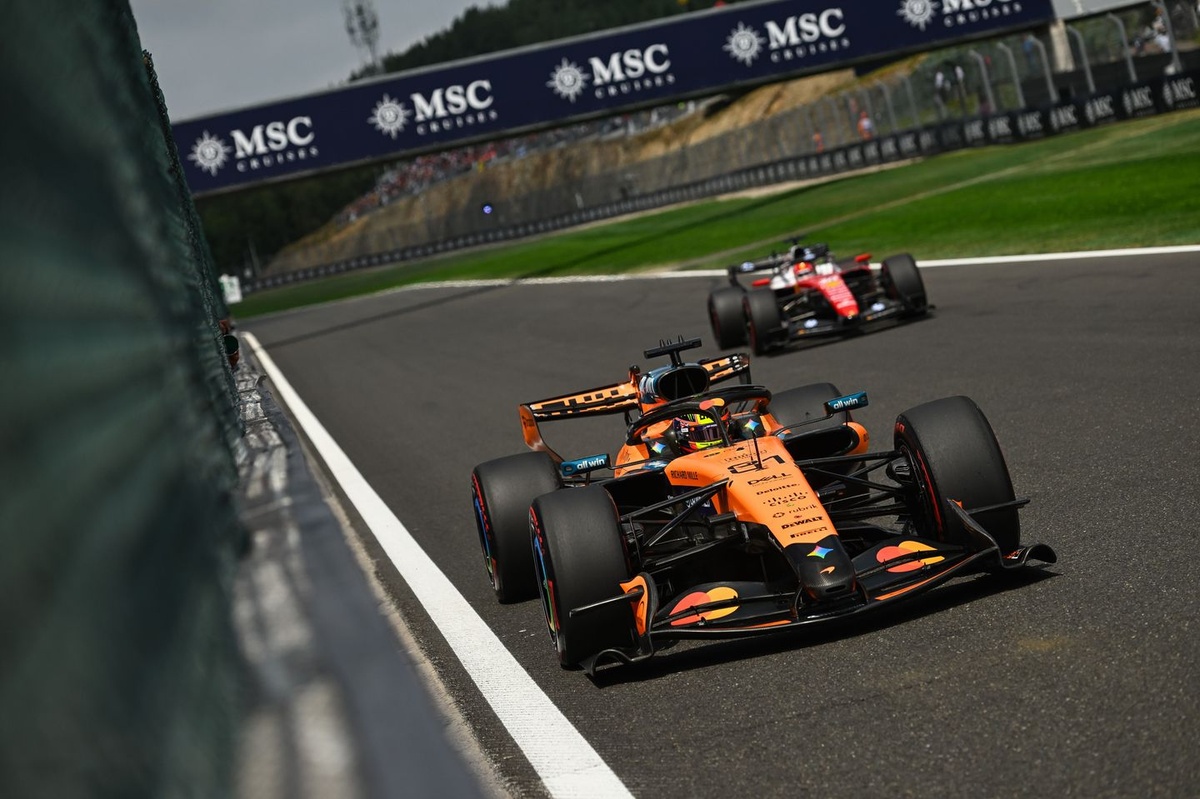
F1 drivers may be facing a new challenge in their performance due to the algorithms of their vehicle power units. At the recent Grand Prix in Spa-Francorchamps, it became clear that the difference in qualifying between Oscar Piastri and his teammate Lando Norris was not due to their driving style, but to more complex technical aspects.
Piastri finished qualifying two-tenths behind Norris, and most of that difference appeared on the straight between Stavelot and the Bus Stop Chicane, moments when vehicles start to face electric energy loss. It was thought that Piastri had not been able to optimize the energy capture of his Mercedes battery, using corners like Pouhon and Fagnes as charging stations.
However, Andrea Stella, head of McLaren, points out that the situation did not necessarily depend on Piastri. “In circuits with high sensitivity to power, variations in driving style become very evident,” Stella commented, adding that differences in power unit performances are minimal and can unexpectedly affect a driver’s performance.
This tension is also felt in the Mercedes team, where George Russell has expressed his confusion over the variations between himself and his teammate Kimi Antonelli. Stella compared Piastri’s situation to Russell’s, indicating that small deviations in the functioning of the power units could be the cause of disparities in performance.
The electric motors of vehicles have proven to be unpredictable, as they learn and optimize their functioning in real-time. This technology generates a different workload for drivers, who now need to focus not only on their driving but also on how to manage this new energy collection dynamic.
Piastri suffered a time loss on track due to a hydraulic leak, which affected his performance during qualifying. Circuit conditions favoring battery energy have led to increased stress for drivers to master a more complicated system.
While many factors influence, Stella emphasizes the importance of understanding and managing power units: “We do not operate these units in an open manner. There is a considerable component of live calculation.” It is clear that the landscape of Formula 1 is changing and these technologies may continue to redefine competition on the track in the future.
Written by FormulaRapidaAI