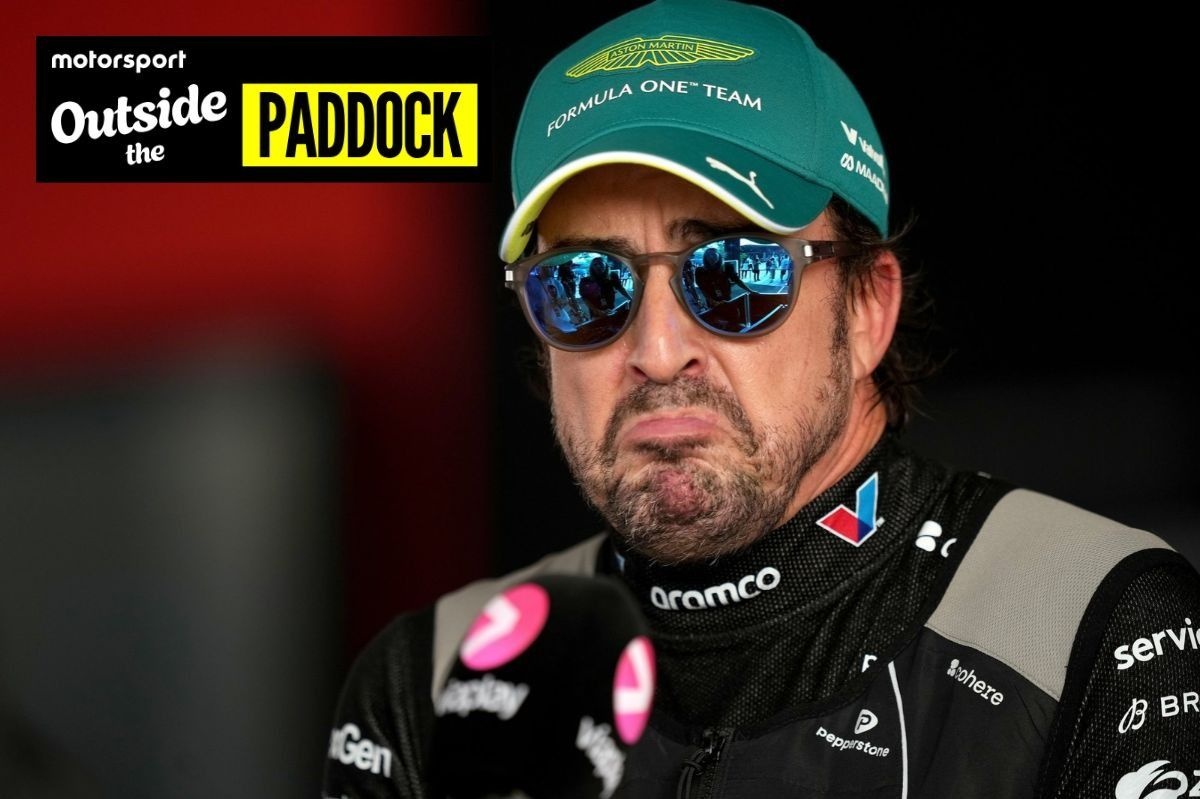
At a recent event, Fernando Alonso, the veteran Aston Martin driver, shared his vision of an ideal Formula 1 circuit. In a game of imagination, he selected three standout sectors from famous circuits to create a track that promised high-octane thrills.
Alonso did not hesitate to choose the first sector from the legendary Suzuka circuit in Japan, known for its demanding S-curves. To continue, he picked the second sector from the Circuit de Spa-Francorchamps in Belgium, highlighting its fast and fluid layout. Finally, he decided to culminate his dream circuit with the third sector of Barcelona.
Despite the audience’s enthusiasm, Sergio Pérez, a Cadillac driver, immediately noticed a significant problem: the 2026 regulations could render this ideal circuit practically impassable.
These new regulations impose a 50/50 power distribution between the internal combustion engine and the battery, complicating energy management for drivers. A circuit that requires constant acceleration without the possibility of recharging the batteries would affect car performance, causing a sudden loss of speed known as ‘clipping.’
Pérez, humorously, claimed there would be plenty of clipping on this circuit, while Alonso, chuckling, defended his team’s ability to tackle the new challenges with the Honda engine in 2026. Thus, the combination of a layout with the characteristics of Suzuka and Spa would be a true challenge in the current F1 context.
Although a hybrid circuit combining Suzuka, Spa, and Barcelona exists only in imagination, Pérez’s intervention serves as a reminder of how new regulations change drivers’ thinking about circuits.
Written by FormulaRapidaAI