


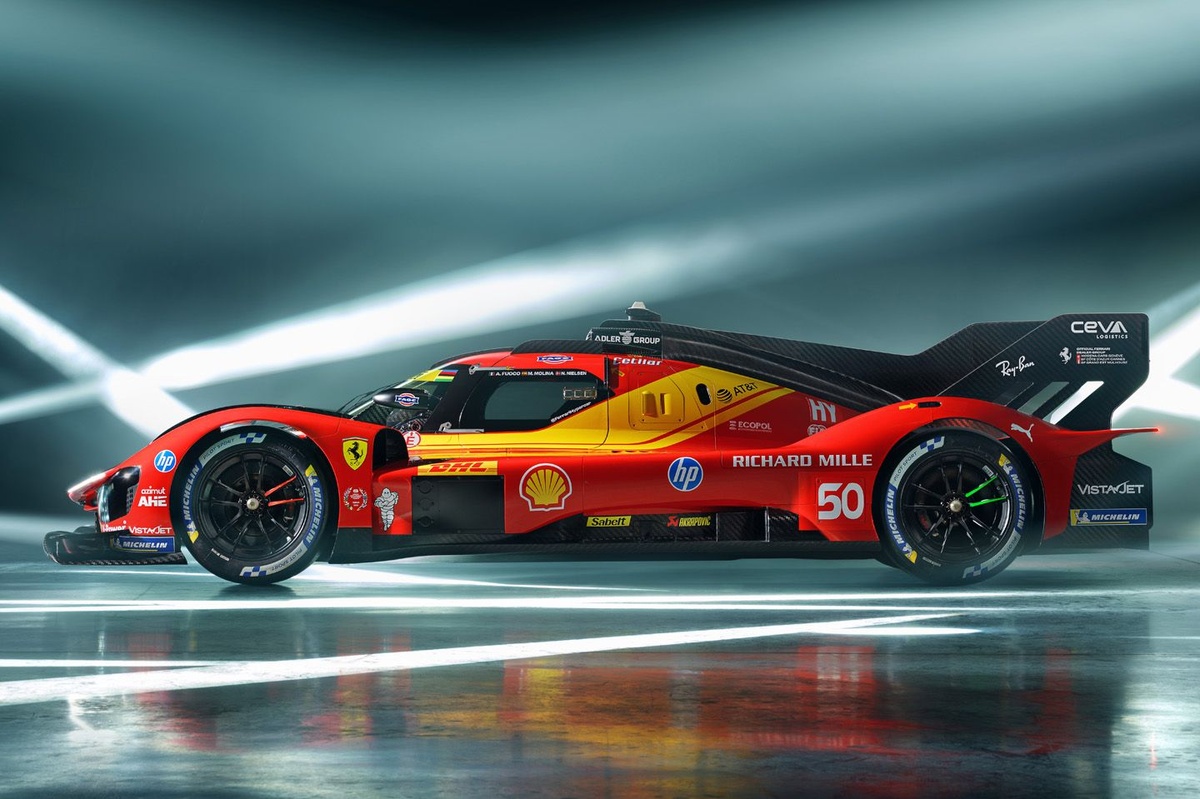
The Ferrari 499P, presented at the Enzo Ferrari Museum in Modena, is preparing to face the 2026 FIA World Endurance Championship with several small modifications. Ferrari’s head of endurance cars, Ferdinando Cannizzo, detailed the work done to adapt the vehicle to the new demands of the FIA and ACO.
For next year, the FIA, ACO, and IMSA have agreed that all vehicles built under LMH and LMDh regulations must undergo a new homologation process at the innovative WindShear wind tunnel, located in Concord, North Carolina. This measure will allow the collection of additional data that will help refine the Balance of Performance framework.
At the end of last season, which concluded with the drivers’ and manufacturers’ titles, the Maranello brand stated that it would not invest in significant updates for its car. Additionally, it continued to analyze and develop the data obtained throughout the competition.
Despite this, Ferrari carried out meticulous aerodynamic refinement work. The changes made were aimed at ensuring that the car complies with the required homologation without altering the original concept, remaining within the performance range defined by the technical regulations for Hypercars.
Following the presentation of the new decoration of the vehicles that will be driven by teams formed by Miguel Molina, Antonio Fuoco, and Nicklas Nielsen, as well as James Calado, Antonio Giovinazzi, and Alessandro Pier Guidi, Cannizzo elaborated on the modifications made to the car.
“The new homologation process essentially involves three aspects. The change from the Sauber wind tunnel to WindShear, therefore, from the tunnel in Switzerland to the United States. A new process of data acquisition and analysis, including new measuring points in the wind tunnel. And finally, a redefinition of the performance range,” Cannizzo commented.
The aerodynamic changes include modifications to the aerodynamic appendages above the splitter, management of the airflow around the wheel arches, as well as adjustments to the floor deflectors and flow diverters to attempt to balance the car’s performance.
At the rear, small changes have been made to the radiator outlets, and the engine cover has been redesigned, significantly increasing the appendages of the rear wing. According to Cannizzo, these changes are minimal but effective and have been approved without touching the vehicle’s main surfaces.
With a 2026 season marked by intense competition, Cannizzo anticipates a high level of competitiveness with rivals like BMW, Cadillac, Toyota, and Alpine competing with significantly updated versions of their respective vehicles. “We expect the competition to be very fierce and that we must perform well in all aspects of the car and team operations,” he added.
Although Ferrari has chosen not to spend its evolution resources on substantial changes right now, Cannizzo warns that the need for more significant updates is approaching as the competition intensifies and the available options decrease.
Regarding the new technical regulations aiming to bring LMH and LMDh platforms closer together, Cannizzo emphasized the importance of the work Ferrari is committed to undertaking, with preliminary discussions already taking place to establish the overall goals for the future of the Hypercars championship.