
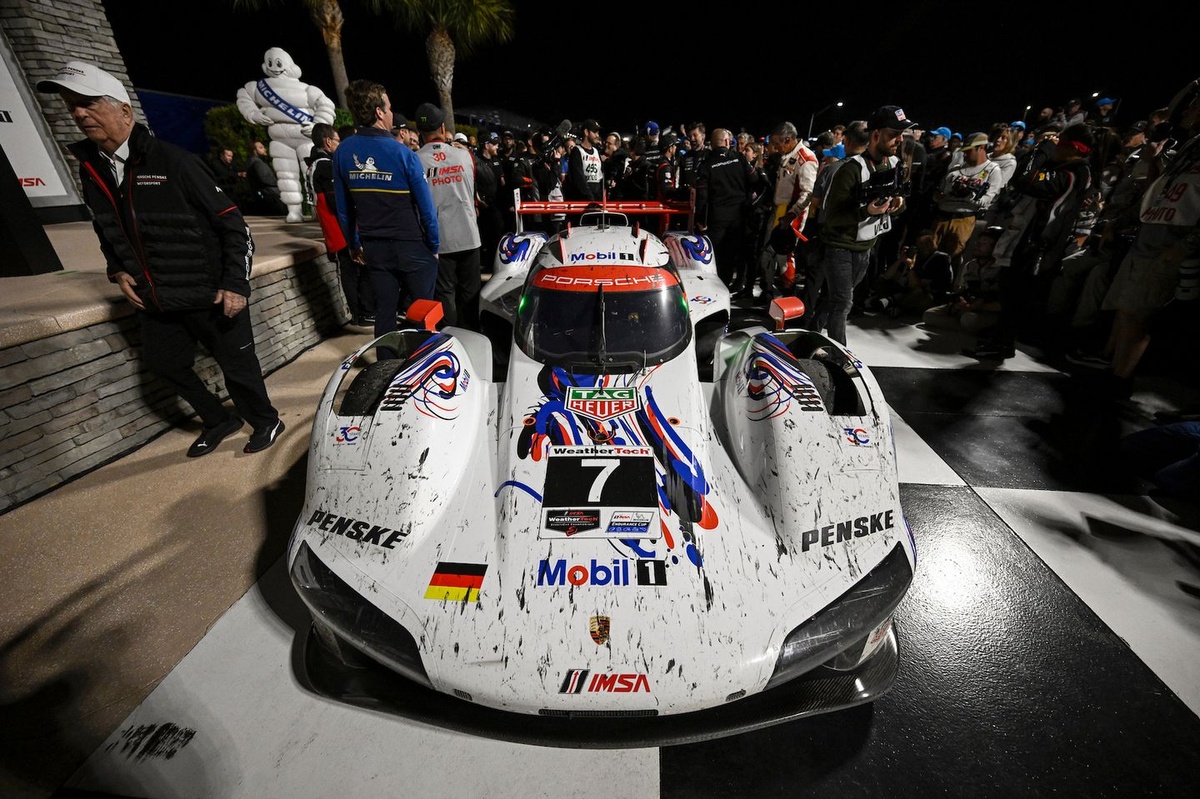
The Porsche 963 will mark a turning point in IMSA competition, as for the first time in the history of Hypercar/GTP regulations, the highest weight of 1,100 kilograms is assigned. This change comes after its decisive victory at the 12 Hours of Sebring, where it achieved an impressive 1-2. This implies an unfavorable power-to-weight ratio of 480 kilowatts per 1,100 kilograms.
The International Automobile Federation (FIA) established a weight increase limit of 70 kilograms for LMDh vehicles starting in the 2024 season, motivated by the superiority of other brands like Toyota in the World Endurance Championship (WEC). Now, this penalty will be applied for the first time in IMSA, meaning Porsche will face much tighter competitiveness with its car.
Impact of the weight penalty
The weight penalty for Porsche is significant, increasing by 45 kilograms since Sebring. Under these conditions, the Porsche will compete in a key speed range of up to 190 km/h, with a power-to-weight ratio of 2.292 kg/kW. Compared to other models like the Aston Martin Valkyrie, which enjoys a more favorable ratio of 1.981 kg/kW, the difference is notable.
Although the news of the extra weight dominates the headlines, other brands have also been affected. The Acura ARX-06, for instance, will increase by 8 kilograms, while the Cadillac V-Series.R faces a penalty of 15 kilograms. This leaves the door open for a more balanced competition at Long Beach.
Classification and competition outlook
The classification of GTP vehicles at Long Beach will be as follows:
- Aston Martin Valkyrie: 1.981 kg/kW
- BMW M Hybrid V8: 2.057 kg/kW
- Cadillac V-Series.R: 2.070 kg/kW
- Acura ARX-06: 2.117 kg/kW
- Porsche 963 (2025): 2.123 kg/kW
- Porsche 963 (2026): 2.292 kg/kW
These new dynamics raise interesting questions about how teams will adapt to the new conditions and whether the heavy penalty for Porsche could lead to more intense competition in future races.
Written by FormulaRapidaAI