Adrian Newey talks about working at Aston Martin and preparing for the new F1 cycle starting from 2026 and getting things right and in place.
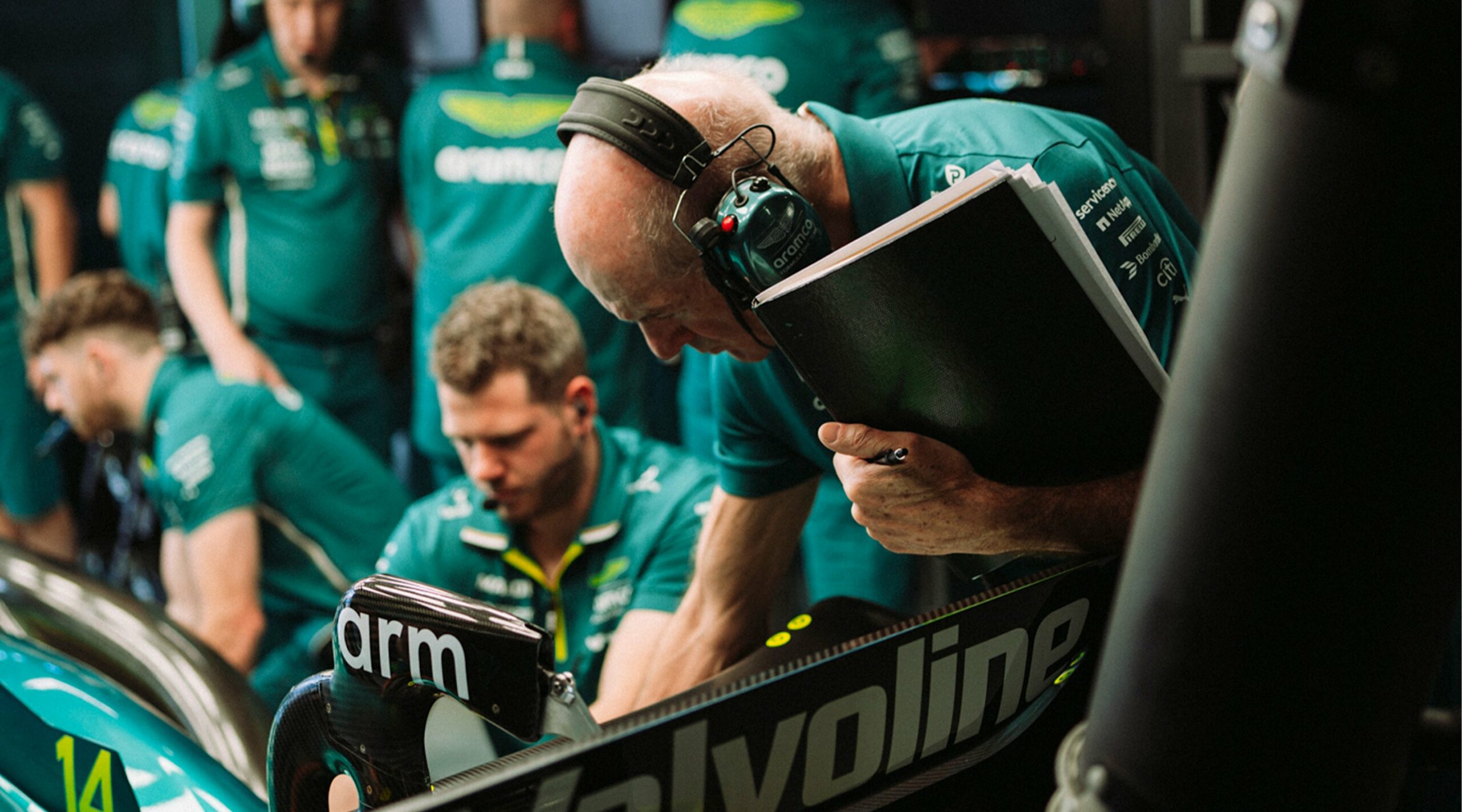
The work that started early in the year is now close to fruition at Aston Martin with barely few months remaining for things to kick-off for 2026 F1 season. Newey has been on scene at the Silverstone base of the team, not only settling himself in but also extracting the maximum from the team around.
It is a big step for Aston Martin in 2026, who will also attain works status with Honda. Newey has been collaborating with pool of engineers to get everything right and together. “We are in a period of transformation,” he said. “As a team, we’ve grown rapidly. We now need to settle everybody down and get them working well together. I’ve never been a believer in saying, ‘We will now achieve this or now achieve that.’
“I think the satisfaction comes from working together to move forwards. If we can achieve that in 2026, that will be the first tick. We are a team of 300 engineers. Collaboration is the most important single aspect. It’s about how we all work together to make sure we communicate and extract the most from each other. For me personally, that means I spend probably around 50 per cent of my day working with the other engineers, either on a one-to-one level, gathered around the CAD station, or in meetings.
“I never want it to not be with everybody’s involvement and buy-in. [My mantra is] perform at your best. Set your PBs. It’s about getting satisfaction from your work. If you feel you’re doing the best job you can, then derive satisfaction from that. That will be greatness. Be curious. Look around. Talk to your colleagues, your peers. Try not to pester them, of course, but don’t be afraid to ask questions. There will be setbacks.
“Try to get through it, and be aware that life is not flat, both personally and professionally. You have your good periods and your bad periods. Enjoy the good periods, but if you’re in that bad period, these things always change,” summed up Newey, who noted the large scale of work for 2026. Considering the change in regulations, it is lots of things that they have to get right.
“Formula One cars have become very complicated beasts as a result of the computer age allowing much greater in-depth research,” continued Newey. “The result is a car that comprises almost 15,000 parts, and when you’re looking at something like next year’s car, where we have a big regulation change for 2026, almost none of those parts will be carry-over.
“It’s a mammoth design and engineering exercise. What I enjoy is looking at it holistically. Any Formula One team is similar in that it has an aerodynamic department, a mechanical design department, and a simulation and race engineering department. Trying to make sure all those work together, that we have a unified product, not only in its detail but, more importantly, in its concept is a process I find fascinating. I’ve been in the business for a long time, since I graduated in 1980.
“I’ve seen a lot of change in that time, particularly as a result of the computer age and the depth that we can now go into research. Those tools allow us that much greater depth and understanding, but they are exactly that: tools. It still takes the human being to come up with the ideas and to then use those tools to the best of effect. If you take the example we have now, where we’ve got a big regulation change for 2026, we’re trying to understand the implications of the rule changes, including how the power unit – with its greater electrical side – affects the chassis design and the vehicle dynamics of the car.
“It’s a very complicated equation. Even with AI advancing as rapidly as it is, we’re a long way off. It depends very heavily on human ideas, and that really is the essence of F1, that ability to conceptualise, to react quickly, to be self-critical,” summed up Newey, while stressing that the drivers are key part of the journey too. Even though they are not the makers of the car, their feedback is important.
They are the ones who will push the car to the limit and ultimately extract every inch of performance on track. The simulator works is essential as well and Newey understands that the synergy has to be 100% between the driver and the car to get the desired results. “When I started, there were no onboard data recorders, no telemetry,” he said.
“The input of the driver was absolutely critical because the only clue the race engineer had about how the car was behaving was from what the driver said. As we’ve moved into the data age, where we have literally thousands of sensors on the car transmitting in real time, we can tell a great deal about what the car is doing. Drivers are wonderfully intuitive animals. They will adapt their driving to suit the strengths and weaknesses of the car. All the teams now have driver-in-the-loop simulators.
“These are engineering tools so we can evaluate different setups, fundamental research and the sorts of things that we can’t normally change at a race meeting but we want to know for future development direction. We need the driver-in-the-loop rather than a pure offline simulation because none of us have managed to create a good enough driver model that can articulate what that synthetic model is feeling.
“We need the human to feel it. The driver role is as important as it’s ever been. You could argue it’s even more important now because we have the ability to combine that with the data to understand exactly what the car is doing and what we need to do to make it faster,” summed up Newey.
Here’s Yuki Tsunoda on not realising hitting Lance Stroll
Here’s Franco Colapinto on Lance Stroll
Here’s Gabriel Bortoleto on Lance Stroll