


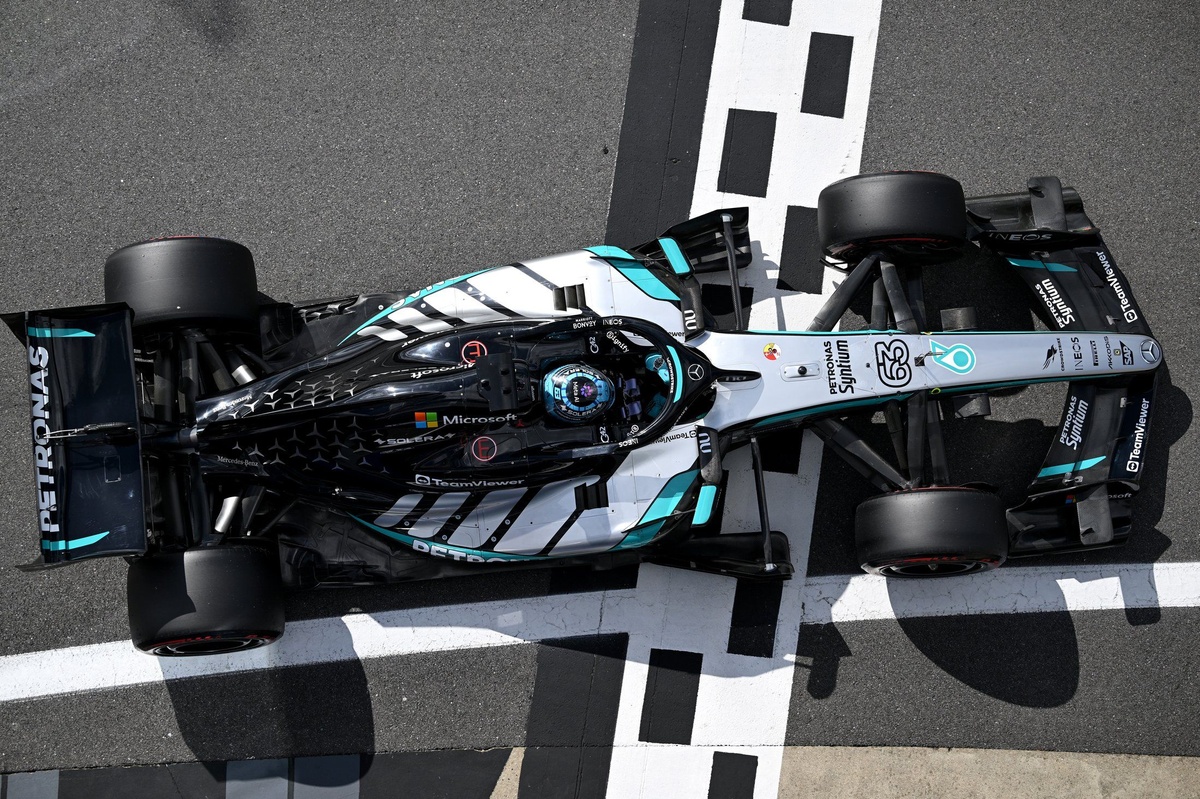
The recent qualifying session of the British Grand Prix has highlighted a surprising technique from the Mercedes team. Their drivers, in a well-thought-out strategy, lifted their foot off the accelerator just a few meters before crossing the finish line, a practice that is uncommon in the world of motor racing.Mercedes has found a loophole in the technical regulations that allows them to benefit in a manner similar to a previously banned tactic.
After the qualifying session, driver Kimi Antonelli commented on this counterintuitive strategy: “It wasn’t easy. In Q3, I also had to lift my foot, and with these engines, it is difficult to drive naturally. Sometimes you need to accelerate later to carry more speed through the fast corners and only open the throttle before entering the straight.”
Teams are aware that lifting the foot can lead to losses at the corner exits, but they gain in straight-line acceleration, where performance is more significant. In the case of Mercedes, their tactic is based on a deep understanding of the rules, which specify that the power reduction during the operation of the MGU-K must be gradual.
How power reduction works
The regulations stipulate that power must decrease linearly to avoid dangerous situations. On a fast circuit like Silverstone, if a vehicle were to suddenly disconnect its electric motor, it would lose nearly 500 horsepower immediately, which would pose a danger to the drivers. The reduction must be limited to a maximum of 50 kW per second.
Previously, some teams like Mercedes and Red Bull had found ways to activate an emergency procedure to circumvent this limitation, which led the FIA to ban it during qualifying. Now, Mercedes has found a legal way to achieve a faster power reduction.
The tactic of lifting the foot
Mercedes has investigated whether it could sidestep the rule by lifting the foot off the accelerator. When this happens, the internal combustion engine does not require power, and thus the MGU-K adjusts its output accordingly. Therefore, with careful manipulation of the vehicle’s software, they can maintain the MGU-K at maximum power just before crossing the finish line, thereby achieving a considerable tactical advantage.
At the Silverstone circuit, the distance between the last corner and the timing line is short, allowing drivers to execute this maneuver more effectively. Precision in programming is crucial, as is the drivers’ ability to adapt to this technique.
The director of McLaren, Andrea Stella, expressed his surprise at what he observed during qualifying, acknowledging that the technique may require additional elements that his team has not yet discussed.
With this innovative approach, Mercedes continues to demonstrate its ability to adapt and find advantages within the rules, with the aim of conserving energy and maximizing performance in key situations such as qualifying.
Written by FormulaRapidaAI
SourceID: SRC_fdb6efa2156c4dfc24dd0a345af8443d528e0461