


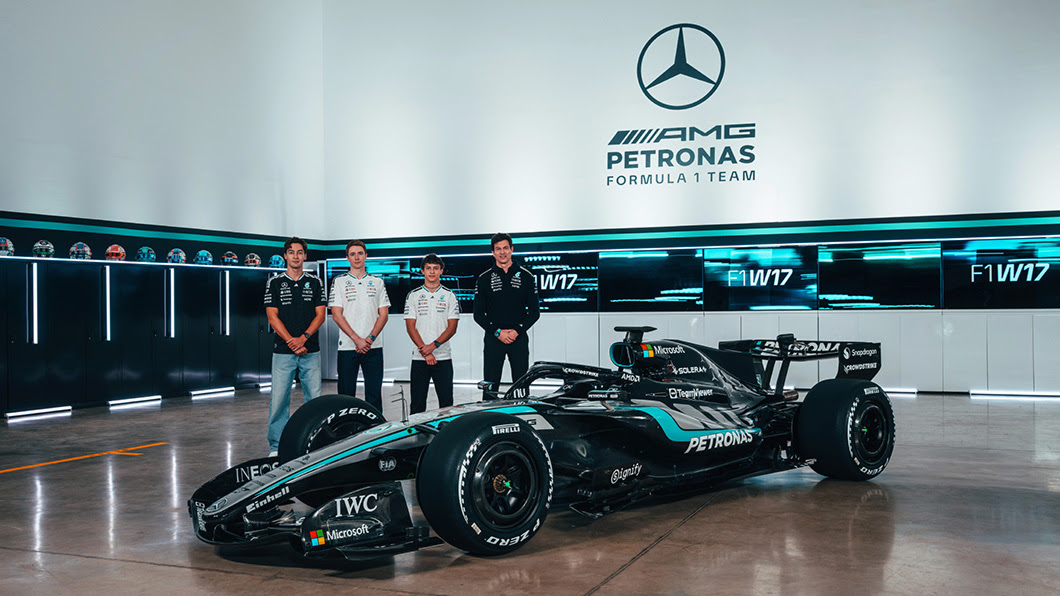
Mercedes launched its 2026 F1 season via digital modem showing livery and car, as Frederik Vesti and Joshua Duerksen get new roles.
As F1 readies itself to enter its next generation, the Mercedes-AMG PETRONAS F1 Team today (2 February) took the next step on the road to 2026 with its digital season launch event. Fans were treated to an in-depth overview of the team’s new car, the Mercedes-AMG F1 W17 E PERFORMANCE, along with hearing from senior personnel and drivers.
“2026 represents a decisive moment for our team and for the sport,” said Toto Wolff, Mercedes-AMG PETRONAS F1 Team CEO and Team Principal. “The upcoming season will be shaped by some of the most demanding technical regulation changes we have faced. These rules will test every aspect of our organisation, while also creating significant opportunities to innovate and set new performance benchmarks. We approach this next era with clear ambition, focused execution, and an uncompromising commitment to delivering results.”
Power Unit and Fuel: The Next Generation of Hybrid Performance
At the heart of the W17 is Mercedes AMG High Performance Powertrain’s (HPP) all-new hybrid Power Unit, created for the 2026 rules: A near 50:50 split between internal combustion and electrical power output. Removal of the MGU-H and a step-change in MGU-K capability from 120 kW to 350 kW, with new energy recovery and deployment strategies.
Advanced sustainable fuel from PETRONAS, engineered as a drop-in solution to deliver performance with reduced lifecycle carbon impact, aligned to F1’s sustainability pathway. The Power Unit has been tightly integrated with the W17’s cooling architecture and aerodynamics to ensure thermal robustness and energy efficiency in every phase of the lap-from high-recovery braking zones to long full-throttle running. The integrated Brackley-Brixworth approach has been a central theme of the team’s journey towards this next generation of F1.
Hywel Thomas, Managing Director of Mercedes AMG HPP, said: “The 2026 Formula One season marks an entirely new chapter- for the sport in general and particularly for those at the coalface of powertrain development. As Managing Director of Mercedes AMG High Performance Powertrains, I’ve never seen a challenge like this: new Power Unit architecture, sustainable fuels, greater hybrid emphasis-all converging at once together with a whole new car. It’s not merely an evolution; it’s a revolution.
“What distinguishes this era is the pace at which we must learn. The integration of advanced sustainable fuels, increased electrical hybridisation and newly defined energy deployment strategies demands a faster feedback loop. We can’t rely on long testing cycles to polish solutions; we must design, simulate, validate, and refine in tighter intervals. Efficiency isn’t just a buzzword; it’s mission critical – both on the dyno and the track.”
Datuk Sazali, Executive Vice President and CEO Downstream, said: “Fuel is fundamental to performance in F1 as it powers every lap and every acceleration on track. For PETRONAS, the 2026 regulations have reinforced the need to formulate fuels differently, with performance, efficiency and sustainability designed together. Our bespoke advanced sustainable fuels are the result of years of formulation work and continuous engine testing, ensuring they meet the extreme demands of racing.
“What differentiates our approach is how we formulate the fuels, lubricants and fluids as one complete performance system. From PETRONAS Primax fuel to PETRONAS Syntium engine oil and PETRONAS Tutela hydraulic fluid, each formulation is purpose-built to unlock the car’s full potential. This reflects our long-standing role in motorsport, and our strong commitment in applying the learnings in F1 to help shape the next generation of fuel and fluid technologies.”
Chassis and Aerodynamics: Smaller, Narrower, Lighter
The W17 has been conceived around the new chassis regulations that set a shorter wheelbase (-200 mm), reduced width (-100 mm), and ~30 kg lower minimum weight. Active aerodynamics-movable front and rear wings – will help to balance drag and downforce across straights and corners. Other changes include narrower front and rear tyres to cut drag and mass, complementing the aero reset and revised suspension kinematics, plus the removal of the Drag Reduction System in favour of increased energy deployment with Boost and Overtake modes to provide good racing.
“The 2026 season represents a significant moment in the sport’s history. For those of us who live and breathe engineering, it’s both exhilarating and daunting in equal measure,” says the team’s Technical Director, James Allison. “This isn’t just a tweak to the regulations – it’s a wholesale transformation of almost every aspect of the car. Power Unit, chassis, aerodynamics, tyres: all are being changed at once.
“We hope we have brought the necessary courage and commitment to make the project a success. We have made our best judgements during the design phase, and we will continue to innovate relentlessly now that the cars are running. Personally, I relish these moments. Regulation changes are the lifeblood of F1 advancements. They challenge every assumption and reward teamwork and ingenuity. They bring high levels of stress, but they also bring opportunity. If we emerge from this transition with a competitive car, it will be one of the most satisfying achievements imaginable.”
Drivers: Building on a Successful First Year Partnership
George Russell and Kimi Antonelli remain as the team’s two race drivers after a successful first year as a pairing in 2025. George took two wins en route to fourth in the Drivers’ World Championship with Kimi showing plenty of promise as a rookie, securing multiple podium finishes and a maiden Sprint pole position in Miami. Fred Vesti, another graduate from the team’s junior programme, steps up to become the team’s Third Driver. Fred will anchor simulator work, attend race events and combine this with an active racing programme in IMSA.
Toto said: “George, Kimi, and Fred represent everything our driver programme stands for. George has become one of the most complete and dependable racers in the sport, a benchmark in speed, intelligence, and leadership. Kimi brings talent and fearlessness, matched with an eagerness to learn that accelerates his growth. And Fred, in his role as Third Driver, provides vital continuity and technical insight that strengthens us behind the scenes.
“All three are alumni of our Junior Programme and their skills are complementary. They will continue to both push and support each other; as we enter this new era of regulations, that collaboration-on track, in the simulator, and within the garage-will be an important force in driving the team forward.”
The team also welcomes several new Development Drivers. Doriane Pin, last year’s F1 Academy Champion, graduates from the junior programme and will take on additional responsibilities in this role. F2 race winner Joshua Dürksen also becomes a Development Driver; the Paraguayan will carry out simulator duties and several days of Testing of Previous Cars (TPC) running alongside his F2 programme. Former F1 driver Anthony Davidson, who has been a core part of the development work on the 2026 car, also continues his simulator support and simulator driver roster management too.
Identity: A New Look for a New Era
Having unveiled a tweaked team logo design featuring a cleaner, more refined look, the W17 sports a striking new livery; it marks this new era with a bold expression of identity and evolution. A dynamic PETRONAS green flow line anchors the design, sweeping low across the car to emphasise speed and precision while harmonising the transition from iconic Mercedes silver to the team’s deep black. The top of the sidepods feature the AMG-specific inspired rhombus signature, complementing the iconic Mercedes three-pointed star pattern on the engine cover.

Here’s F1 stats from Barcelona running
Here’s Mercedes named for full season re safety and medical car
2026 F1 livery reveals so far –
Red Bull, Visa Cash App RB with Ford
[The story is as per press release]