


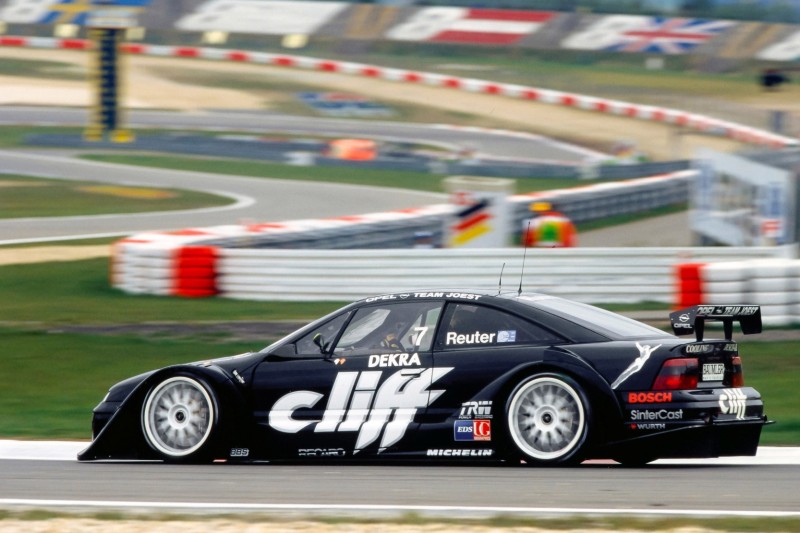
Three decades ago, Manuel Reuter made history behind the wheel of the legendary Opel Calibra, winning the ITC (International Touring Car Championship) title at Interlagos on October 27, 1996. This victory not only marked a key moment for Opel, but also signified the end of the era of the old DTM.
The car that Reuter drove was technologically so advanced that it was compared to a Formula 1 vehicle. With regulations allowing for great technical freedom, Reuter achieved his only drivers’ title in Opel’s history. ‘At that time, we were really at the level of Formula 1,’ Reuter commented about the vehicle’s sophistication, which included innovations like active aerodynamics and a DRS system that was banned after one race.
The budgets of the manufacturers were exorbitant, with approximately 100 million German marks (51 million euros) per team, surpassing the resources available to Michael Schumacher’s Benetton team during his second Formula 1 championship. The races, moreover, took place on renowned circuits around the world like England, Italy, Brazil, and Japan.
A fierce competition
Elite drivers like Nicola Larini, Juan-Pablo Montoya, and Giancarlo Fisichella competed behind the wheel of 520-horsepower vehicles. Although electronic aids were banned in Formula 1, ITC technicians could continuously innovate. ‘Each race we introduced new features,’ Reuter recalled about the thrilling competitive atmosphere.
Extreme innovations
The vehicles from Opel and Alfa Romeo featured electronically controlled differentials and engines that tested great technological advancements. Mercedes’ response was a sophisticated weight distribution system, along with other elements like a semi-automatic gearbox and adjustable anti-roll bars while driving. ‘We had engines intended for qualifying, lasting 50 kilometers,’ Reuter explained, highlighting the intensity of the competitions.
The road to victory
Despite the preparation, Opel faced difficulties at the beginning of the season. Reuter won in Hockenheim, but internal competition was strong, with drivers like Klaus Ludwig and JJ Lehto in the team. Internal tensions were evident on several occasions, especially between Reuter and Ludwig, who was already an established champion.
A spectacular finale
The title decision took place far from home, in Sao Paulo, where Reuter had a series of setbacks before the races. Despite this, he managed to distance himself from his closest rival, Bernd Schneider, at critical moments. In the end, the Opel driver was able to celebrate victory in front of an enthusiastic crowd, acknowledging that the title was a key moment for both his career and the brand.
Today, 30 years later, both Reuter and Schneider remain connected to the motorsport world, reflecting on the legacy they left behind. Reuter is preparing to celebrate his 65th birthday in December, cherishing the memories of an era that changed the touring car racing landscape forever.
Written by FormulaRapidaAI
SourceID: SRC_01c2e9056383fd15973eed8806a9cf551d256c87