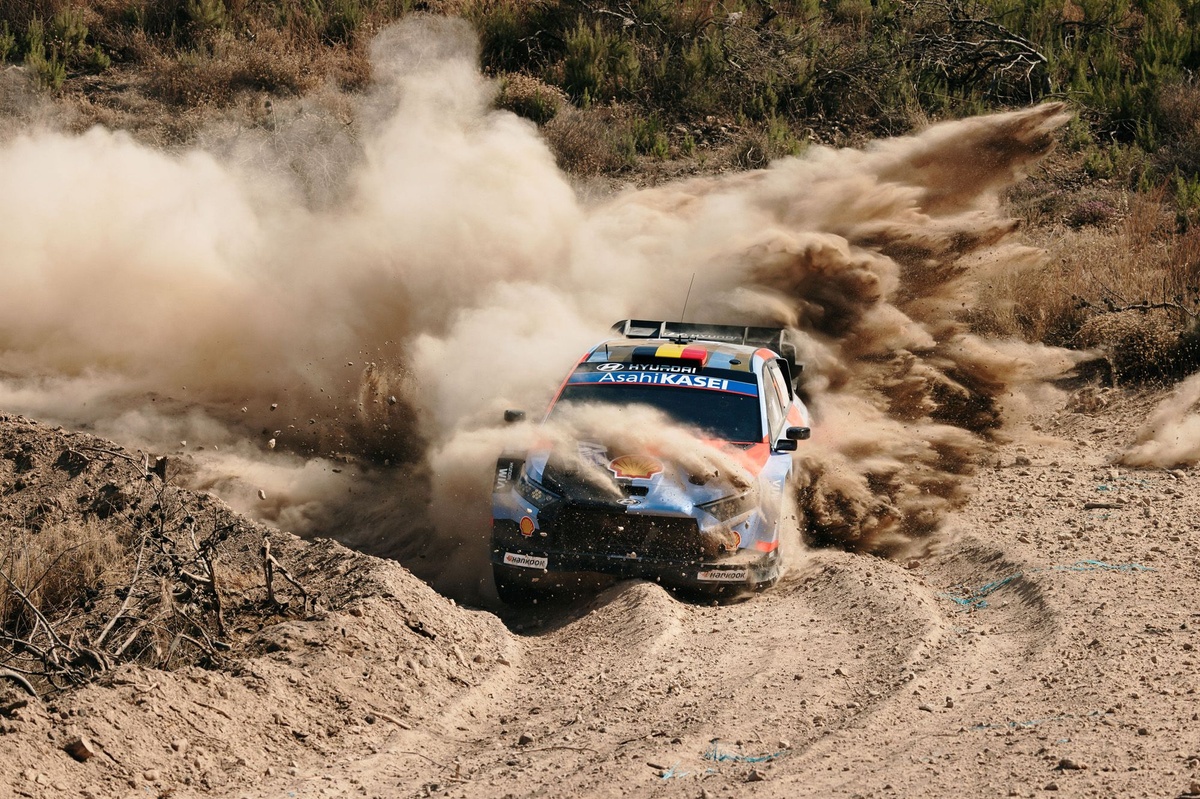
Hankook is considering the possibility of creating a custom tire to face the extreme conditions of the Acropolis Rally in Greece in future editions. This latest event in the World Rally Championship (WRC) tested the tires more than ever, with numerous punctures that influenced the race outcome.
The difficulty of the terrain in Greece was a key issue throughout the competition, where poorly maintained gravel roads caused several punctures. Hankook brought an updated version of its hard-compound tire after receiving criticism about the durability of its tires during the Rally of Portugal. Just before the Acropolis Rally, the brand validated an improvement in the tire by increasing the thickness of the tread.
The WRC teams acknowledged that this improvement was a significant advance in limiting delamination, but punctures remained a point of debate. Only two drivers, Sebastien Ogier and Josh McErlean, managed to avoid punctures throughout the race, which featured a more rugged route than in previous years.
Ogier, who had lost a likely victory in Portugal due to a puncture, confirmed that the new tire was an advance, but believes that the ultimate solution would be for the manufacturer to develop a specific tire for this event due to its extreme conditions.
During the Rally, Ogier led a proposal to shorten stage 12 by 4.5 km due to the road conditions, which he considered too harsh for the tires. “The tire we used in Portugal wouldn’t have lasted one stage here,” Ogier commented, adding that the only solution would be a tire designed exclusively for Greece.
A representative from Hankook commented that it would be worth studying the possibility of developing a tire for the rally. “It’s a very large task, but if we believe it is important for the sport and if there is broad support, we can consider it,” he said. The brand expressed mixed feelings as a significant effort was made to improve before the rally, and subsequent comments acknowledge the advances made in the tires.
Regarding the most prominent punctures, Thierry Neuville suffered a double puncture that kept him from fighting for victory against Ogier in the decisive stage. Neuville highlighted that the solution does not only depend on improving the tires but that the selection of roads by the organizer could help minimize risks.
The director of the M-Sport-Ford team, Richard Millener, noted that the development of modern WRC cars makes the job of tire manufacturers extremely complicated. According to him, “with cars that are faster than ever and drivers pushing harder than ever, the tires must withstand extraordinary pressure.”
Written by FormulaRapidaAI