


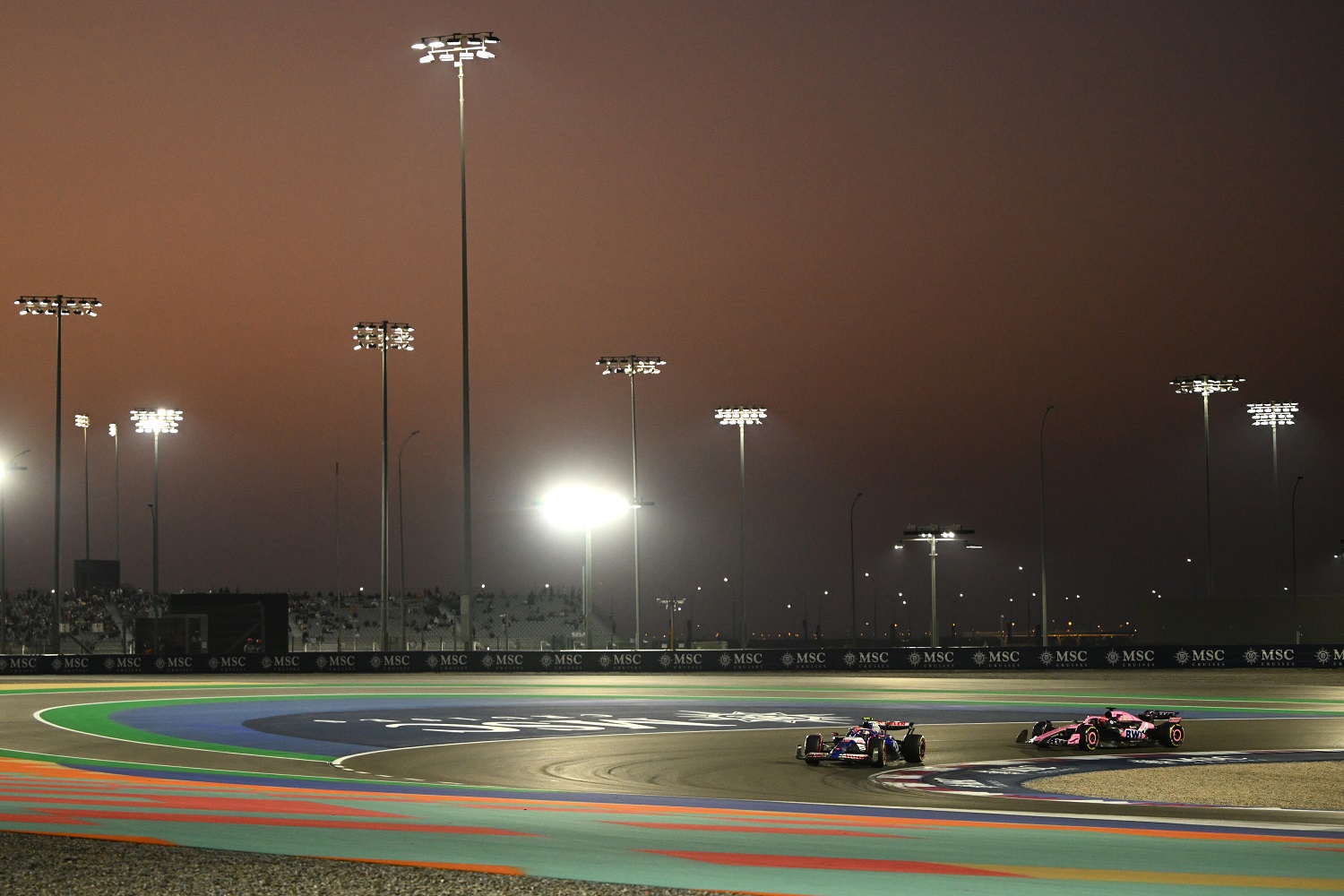
The FIA shared details of F1 Qatar GP in terms of track limits, DRS, circuit changes and more, as drivers share thought about drivers’ meeting.
The white lines will continue to denote the track limits in F1 Qatar GP at Lusail circuit as per FIA Race Directors’ note, but it has put out that dotted lines at pit exit road will mark as the track edge. Additionally, the stewards will monitor Turn 16 for potential track limits violations.
The FIA also reminded about Pirelli’s note of 25-lap limitation on tyres due to excessive load. The Race Director listed out host of changes made from last year at Lusail, which includes gravel strip additions at various corners. They are:
- Additional gravel strip at the exit of Turn 6.
- Additional gravel strip at Turn 10 on the right-hand side.
- Gravel strip at the exit of Turn 14 starts earlier.
- Additional gravel strip at the exit of Turn 16.
- Gravel beds have been painted.
In terms of DRS zones, the lone detection zone is 40m after Turn 15 and its activation is 305m after Turn 16. As for the FIA stewards, Garry Connelly will lead the pack for F1 Qatar GP, with the support of Loic Bacquelaine, Derek Warwick and Amro Al-Hamad.
Here’s F1 drivers on penalties and drivers’ meeting –
Andrea Kimi Antonelli: “Yeah. I mean, that’s why today we’re having a meeting about driving guidelines, especially for next year. Definitely, we’re going to give our input based on our experiences, trying to help the FIA to set a new driver guideline standard that allows better racing. I didn’t think this year was too bad. The driver guidelines — of course, you can use them in your way, in your favour — but I don’t think it needs massive change. And then about the plank — that kind of stuff — I mean, that’s the rule. With these cars, the lower you run them, the more lap time you gain. So obviously, you need to set a limit, and if you go beyond that limit, of course you’re gaining an advantage, and that’s why you get a penalty. I remember Mercedes in Austin 2023 — they had the same issue with the plank and got disqualified. Of course, sometimes you have external circumstances, like McLaren might have said they had more porpoising than expected. That’s unlucky, of course, but the rule is the rule. It is what it is. I think next year we’re not going to have as much of an issue with the new regulation.”
Oliver Bearman: “Luckily, we have a meeting with the FIA. I think our main concern as drivers is, first of all, that we don’t have permanent stewards, which is quite challenging because the guidelines are guidelines, and they’re interpreted differently by different stewards. For the level of our sport, if we compare ourselves to other elite sports, we’re one of the only ones with a judging panel that changes race to race, which is challenging for us. And I think just trying to give them a bit of perspective of what it’s like to be in the car. There are some penalties given out this year where, if you ask the drivers, the majority — or all of them — would agree that it should or shouldn’t be a penalty, and sometimes the result from the stewards is different. That’s why we want to create a bit of parity. So, yeah, I think it’ll be a long night tonight with the meeting.”
Liam Lawson: “Not much more to add, honestly. I think it’s just trying to create a way that, when these decisions are made, it’s taken into account what it’s actually like being behind the wheel and driving these cars. The current guidelines were made to try and understand what we were trying to say last year, but they’re ever-evolving. We’ll try to make things even more clear this evening and try to create a better system for next year.”
Carlos Sainz: “I think first, we need to sit together, analyse quite a few of the incidents. I think there’s been quite a lot of division in opinion between drivers, FIA, Stewards—just different ways to judge different incidents. This year, there’s been quite a bit of confusion regarding a few of them. We need to sit together and go through them and analyse them calmly, out of the heat of the moment, like we are now on a Thursday before a race and try to hopefully come up with a better solution for the future. My personal opinion – and here I’m not talking from a GPDA perspective, just as Carlos Sainz – is that there’s potential to do better and that the guidelines themselves have created more problems than solutions in a lot of issues that have happened this year in the way we judge incidents. There’s been barely any room for racing incidents this year. It’s always been either white or black because we’ve been supported by the guidelines, and the guidelines haven’t allowed racing incidents to be judged as racing incidents because there was always a tyre in front or behind a mirror or a front or rear tyre—whatever the guidelines say, I don’t know them by heart. It’s been, in that sense, not a successful implementation of those guidelines.
“But that’s what we need to discuss that’s why we need to sit together and see if there’s any other solution. I’m going to speak as Carlos Sainz, not as GPDA here. I’m going to give you as honest an answer as possible. I think recently after races I’ve seen some analysis done of quite a lot of the incidents. Some of them by Karun Chandhok, some of them by Jolyon Palmer, some of them by Anthony Davidson. And every time I see this analysis that they do and the verdict that they give—from racing drivers that have been recently racing—I think they do a very good analysis and they put the blame correctly most of the time on who actually has the blame or if it’s actually just a racing incident. My future ideal is no guidelines and people that are able to judge these sorts of incidents as well as these three people do after the races. Again, this is just my opinion, but I’m quite impressed at the job some of the broadcasters do after a race with this in-depth analysis of each of the incidents and how they apply blame or no blame into certain scenarios. I think that’s a level of analysis and a level of ‘stewardness’, if you want to call it that way, that I think is very high level. Probably doesn’t mean we’ll agree 100% on the cases that these three ex-drivers give, but I think a lot of times, they are very close—90%, let’s say, correct.
“And if I had to go and see Formula 1 in the future on the stewarding level, this is more or less the level that I would appreciate. This is where I get lost. Like, I don’t know if we need guidelines or not. I just say that when I see these people taking the time to analyse this sort of incident as a driver—when I see how they do it, the language they speak, how they explain it, and obviously the background they have to make this analysis—I really feel like they understood what happened in that incident, and the judgement they take. This doesn’t mean that the stewards don’t do a good job. It just means that what I see after the race from these people is actually a very high level that I think, without guidelines, they would be able to judge each decision correctly. And there wouldn’t be a bias or anything like that. Well, I think I need to be very careful with this. I do think there’s older generation people that do a very good job with the stewarding. I don’t want to name any names. I don’t want to be personal with anyone. But I do think there’s people out there doing a very decent job. The only thing I say—and I insist that I don’t want to get into too much analysis here—is that when I hear these people, these young ex-racing drivers doing analysis, they speak a lot of sense.
“When I read and I say, “If we could have two or three of these judging our racing incidents or our penalties,” I think most of the time these people wouldn’t need guidelines. They would be very honest and very accurate in taking some of the conclusions that we would need them to take. So, I put it out there as an idea. Obviously, nowadays, to come to 24 races, probably you also need a fixed salary. You need the job to be relatively important because it takes a lot of time out of your life. So, we need to look at how to organize that. But again, I don’t want to get into too much analysis here. I just want to say that when I take time to see those back—maybe two days after I go home and it comes up in social media, these people making the analysis—I’m like, I see it exactly the same way. And I think most of the drivers see it in a very similar way. So, it’s an idea.”
Alexander Albon: “Yeah. I would agree with that [taking case-by-case]. I think that we’ve chased a lot of consistency, but the events, it’s hard to ignore. And to be fair, I understand the effort made because I think team principals and drivers chase consistency a lot. But then at the same time, I’d argue the good example of Oscar and Liam in Turn 1 in Vegas had no implication. Am I right in that? Ohh plank wear? Then I don’t agree with it. We all have to factor in limits and there’s a lot of lap time in these cars being a mil lower than from where we are. But of course everyone makes mistakes and I get that bit, but these cars are incredible now. We are setting ride heights down to what winds you get for the next day in the race. If you get a headwind into a main straight, it completely transforms your ride heights for the weekend in terms of obviously a few more points up with the headwinds, puts the car a lot lower and yeah, you get porpoising and then you need to make adjustments to the porpoising as well and estimates. I think it is really tough, the regulation set, so especially on sprint weekends or weekends where we have not much running like Vegas. You have to take the safe approach and sometimes you finish on Sunday as a team kind of kicking yourself because you have hardly any plank wear and you feel like you could’ve optimised the weekend more.
“But that’s just the way that these rule sets are this year. Yes, but it still will be a talking point. I think it’s the philosophy of at least one part of the car, whether it’s the front or the rear of the car, being as low as possible generally still applies. So, it will be much less of a talking point, but it will still be there. Yeah. I mean, we could run these [plank] things to the deck if we wanted to and have no legality issues. But then we’re all finding illegal performance kind of thing, so I think the main thing for me is, I don’t like that it’s random. You’d almost rather have 20 cars get checked every weekend and then you’d have kind of, in terms of fair game, but it’s that kind of random selected version of it which is a bit tricky for it. But yeah, I mean rules are rules. It’s just how…it’s like every day. In terms of driver fights, well, I’ll give you an example, Liam hit Oscar, locked up, very lucky to be wheel to wheel, so no damage to both cars, but obviously, Oscar took a hit. Gabriel had a similar crash but maybe I think equally out of control, but because of the circumstance of Liam was quite lucky that there weren’t cars kind of already in the middle of the corner, so he only made contact with Oscar, but Gabbi starting further back had the bigger crash because he had a good start and he was basically stuck with a multiple amount of cars in front of him so he kind of took the big crash, let’s say. I think Gabbi’s getting a grid place penalty this weekend. So there is a difference in terms of, kind of, there is not the consistency, which is kind of what I was, I misheard the question, but there is a difference in terms of consistency, in terms of policing cause and effect kind of thing.
“And then at the same time, I got a penalty in Vegas, which I think I said already, but I got a penalty in Vegas, five second penalty for clipping the back of Lewis going for an overtake. I had front wing damage, Lewis had no damage and he lost maybe 3/10 of track time, race time. But like I don’t understand like where the rules apply the penalties and what gets you a penalty or whatnot because there’s a tolerance for that one. How big is the tolerance? Well, clearly it’s quite big….as long as you don’t have a huge crash. It will be talked about for sure [in drivers’ meet]. And I think, obviously I’m complaining because I was the one that got penalty in Vegas. But I think it’s positive that we’re having discussions about it. Like I appreciate the FIA and the race directors being open to having discussions about these things, because I think they could take a stubborn approach if they really wanted to, but they don’t. I think they realise it’s becoming a problem, and that’s why they want these discussions to kind of create some openness and create a better solution for the future. I think I said it on my last meeting, but to me it’s impossible to have such strict ruling on each thing if the car’s here, the car’s there, the turning point of a corner, what dictates a corner, track usage and squeezing a driver off the track or not or what’s entitled to your space and what’s not. It’s all almost like you’re driving and you go into a corner and it’s like there’s a rule book of this is this and this. That’s not really racing in my head.
“That’s almost like…we have a scenario of a rule, and then we have another rule that explains the loopholes of the first rule, and then there’s layers to the rules and it makes it complicated to be honest with you. I think, it’s like as drivers we have grown up karting, doing Formula 4, Formula 3, Formula 2, we know what’s on the edge and we know what’s clean driving, what’s dirty driving, what not. I think I said it before, but I kind of abide to my own version of what’s clean and what’s not, and it kind of, to me, makes sense. I think back in the days when there were less rules, it was more flow, more, kind of less question marks, we just, I think, get… tell me if I’m wrong, but I think it was more like Charlie would say what… his version of the incident and everyone kind of just said, ‘okay’, and moved on. And that was kind of the way it was and I think that that’s kind of the direction I would like it to go in because it’s just…yeah, you can do the risky move or you can do the aggressive move or you can do the dirty move, but then you’re putting yourself at risk. It’s almost better in a way in my opinion, because it is not concrete. If you want to be the dirty driver, you want to do the risky thing, it’s up to you to take on that risk. Does that make sense?”
Pierre Gasly: “For me, it was a big misjudgment [in Las Vegas]. And at this level, Gabbi has done a very good season, but at this level, it should not happen, you start on hard tyre last. He didn’t misjudge it by couple of meters. So I think it affected Stroll’s race. It affected my race. We always never really want to look at the outcomes. But in some ways, this costs couple of other guys’ point opportunities. So I don’t think it’s personally too harsh because for me, it was a big misjudgment. It wasn’t like a small one. If it’s a situation where you slightly outbrake yourself, like Liam had, for example, it’s a different. But now, I was just…if you look at the speed he came out on the inside was..if Stroll is not there or like there is no car, he’s ending up miles away. So, I think it’s, yeah, hard tyre, was way too optimistic, so.
“It is a conversation to have where I need more time to think about it. But yeah, I think a different…I don’t have the answer for it now. No, more the action of the driver itself. I think, outcome, consequences is obviously always very different. But I think there is different level of misjudgment. And as much as I like Gabbi and I think he’s done a, a great job this year, this was poor. I mean, I know it wasn’t intentional. It’s one of those things where unfortunately at this given moment, I don’t know if he lost spatial awareness. He’s completely on the inside. You don’t really have marker boards. So I guess this is what happens. In terms of meeting, we’re discussing it with the FIA later. We all want the same outcome, so we have a common goal. And it’s just the interpretation of each individual which us drivers would like to have an input on. What we feel inside the car, with our skills, we know we have a more accurate vision of what it may look like from the outside. I think most of the time it’s quite obvious, when things are not obvious and you need more evidence, then probably that’s a better case. Sometimes I think they’re talking about limited amount of videos, which if you don’t have the full abilities to get a very clear picture on the situation, yeah, you’d rather wait.
“But on some situations it’s really clear and I don’t mind the fact that they are quick at taking actions. I don’t think you should get rid of them [racing guideline] entirely, but they definitely need little tweaks to make it more flexible from one situation to another because from inside the car, you can…by the guidelines there are a couple of situations where you can get away with things which are not very fair. I mean, we’re always going to use the gray areas inside the car. So I think it’s about limiting these sort of gray areas. Just with the front axle at the apex [is what have to discuss about]. Exactly. Inside when you’re a bit short, you might get away by just releasing and carrying way too much speed by putting your nose…I mean you end up with an awkward situation which is way too optimistic in the first place, and sometimes you end up having the opposite where someone is actually closing the door quite early on to force you to either carry the brake, which then lead into a contact. And a couple of scenarios this year where I think the guidelines has proven to be a little bit too rigid. And I think that’s what we want to work on.”
Charles Leclerc: “I mean, there needs to be black and white rules [with regards to plank wear], and those rules needs to be respected. So yeah, I don’t think there’s much to speak about that, to be honest. It’s a very tricky rule because, to be honest, it’s not like, I’m sure none of the teams here are targeting to be illegal. You just try to be on the limit, and with those things, a small change of wind on a track like Vegas, that is quite bumpy in some places can add a lot of things that are very difficult to calculate and to take into account when you set up the car. So it makes it very difficult. However, you’ve got to have a rule. So yeah, I wouldn’t relax it or take it off. I don’t know [about removing guideline]. But this we have also different opinions.
“I think, and everybody think about it a little bit differently. But in my opinion, I think there are many rules and in a sport like racing, it’s very difficult to write black and white every single scenario that can happen. So I appreciate the fact that we are all trying to tackle as many situations as possible, but I feel like this is never ever going to be the case. I would rely a little bit more on the stewards’, feeling on certain situations because…by example, if I take Brazil Turn 1, there we are sticking to a rule that probably doesn’t make sense on that actual situation in Lap 1, Turn 1. And it’s a difficult thing to do, but now today, we are really sticking to the book and that makes it difficult to have common sense sometimes in some specific situations.”
Here’s FIA Race Directors’ note in full: https://www.fia.com/system/files/decision-document/2025_qatar_grand_prix_-_race_directors_event_notes_.pdf
Here’s McLaren drivers, Max Verstappen on title