The FIA shares details and first-look of the WRC27 cars and regulations, as MotoGP details of the stats from the 2025 season.
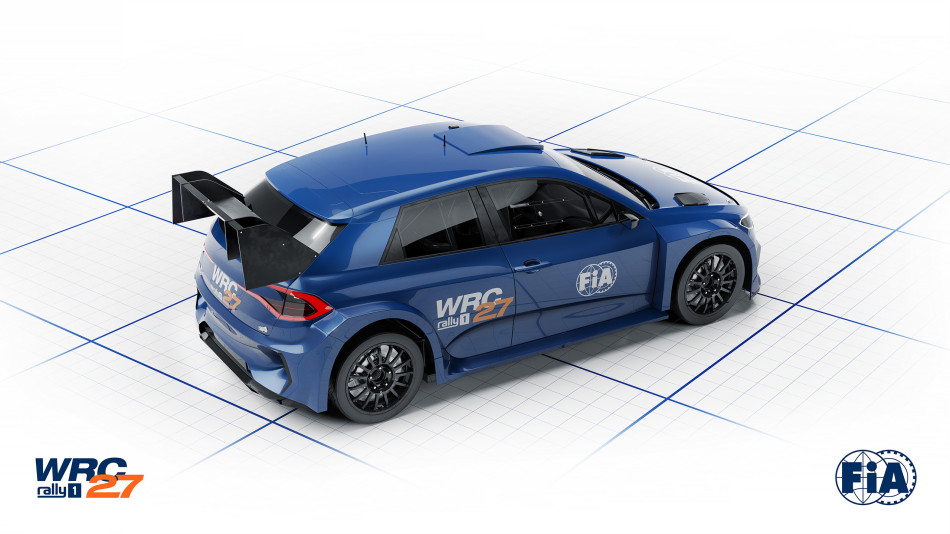
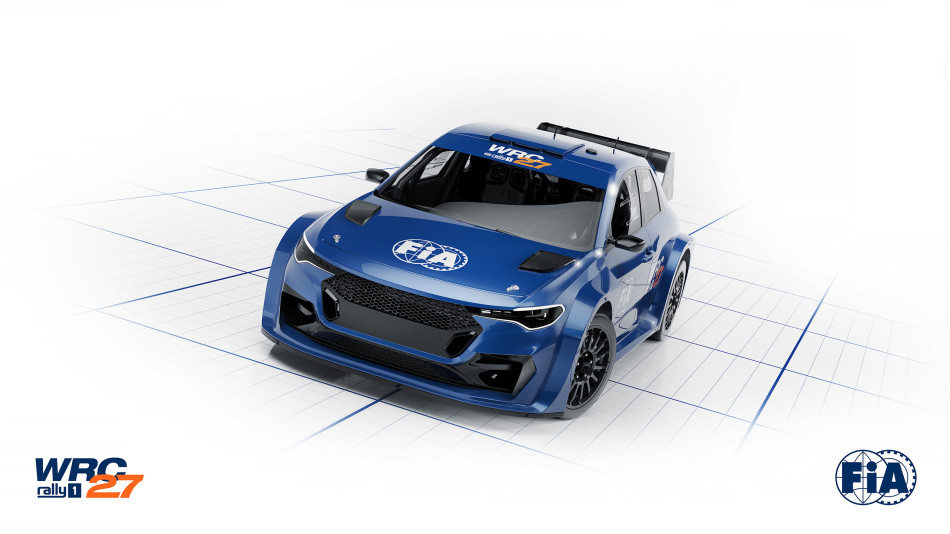
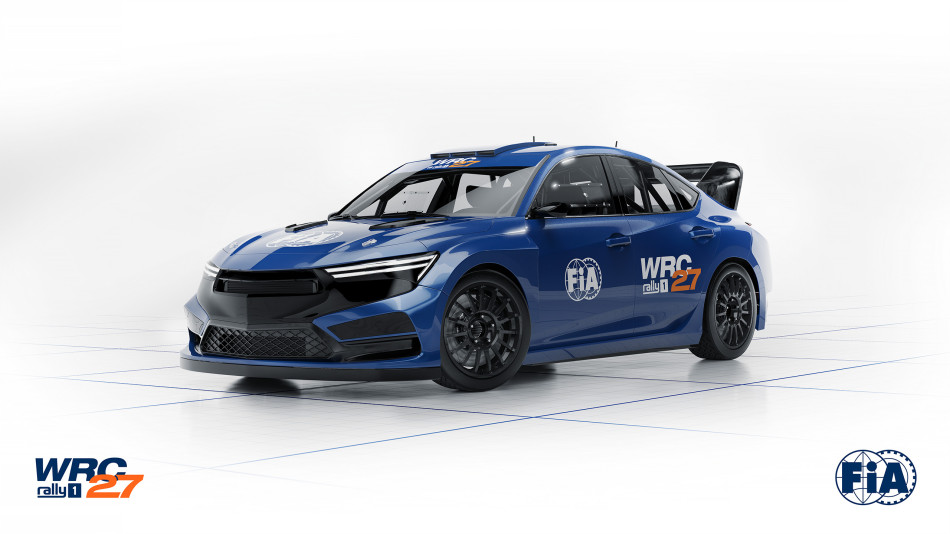
The Fédération Internationale de l’Automobile (FIA), the global governing body for motor sport and the federation for mobility organisations worldwide, has today revealed a first look at the car concept that will form the foundation of the FIA World Rally Championship from 2027. First approved by the World Motor Sport Council in 2024 following extensive consultation with WRC stakeholders, the WRC27 regulations establish a framework designed to improve accessibility, flexibility and cost control at rallying’s elite level, while preserving the performance and spectacle that define the championship. The WRC27 Rally1 concept provides the first visual representation of these principles, translating the regulatory framework into a clear vision for the future of the FIA World Rally Championship.
A safety-led foundation
At the core of the WRC27 concept sits its tubular frame safety cell, building on the structure introduced with the 2022 Rally1 cars. Developed through extensive simulation, benchmarking and prototype crash testing, the new safety cell delivers high levels of occupant protection while reducing overall complexity and cost. Compared to previous generations, the structure offers significant improvements in intrusion reduction and energy absorption across frontal, side, roof and rear impact scenarios.
Flexible vehicle design
Surrounding the safety cell is a bodywork framework designed to prioritise flexibility. Rather than requiring cars to be derived from current production models, the WRC27 regulations define a reference volume within which all exterior panels must sit. Within this volume, Constructors are free to develop a wide range of designs, from production-based designs to bespoke rally concepts. Aerodynamic devices on the new car have also been simplified to reduce development costs and technical complexity.
A Constructor future
The WRC27 regulations open the championship’s top category to a wider range of competitors by bringing both OEMs (Manufacturers) and Tuners under a single definition of Constructors. In defining both entities as Constructors, the WRC27 regulations broaden the field and strengthen competition at the highest level. Under the regulations, a Constructor is defined as the entity responsible for the design and construction of a WRC27 car, its presentation to the FIA for homologation, and the marketing of the car and its associated parts.
Accessible performance
Accessible performance sits at the heart of the WRC27 package, with the target to reduce the performance delta that currently exists between the top-tier and second-tier of competition and make it easier for young drivers to reach the performance window without the need for extensive car-specific testing. The cars will be powered by 1.6-litre turbocharged internal combustion engine producing around 290 horsepower, paired with a four-wheel-drive powertrain and a five-speed gearbox. The suspension is set out in a double wishbone configuration, with braking and steering systems derived from current Rally2 specifications, delivering a cost-effective, high-performance package suited to the unique demands of the FIA World Rally Championship. The WRC27 car is built around a tubular frame chassis, defined within a vehicle footprint with a minimum length of 4100 mm, a maximum length of 4300 mm, a maximum width of 1875 mm, a minimum wheelbase of 2600 mm and a minimum height of 1270 mm, within which Constructors are free to create a wide range of designs.
A restructuring of the Rally Pyramid
As the FIA World Rally Championship enters its next regulatory cycle, WRC27 cars will compete alongside existing Rally2 machinery in the top category, bringing together a broad mix of competitive cars at the highest level of international rallying.
A future-ready powertrain platform
Powertrain flexibility sits at the core of the WRC27 philosophy. While the initial target configuration for the first years of the regulations cycle is a sustainably fuelled 1.6-litre turbocharged internal combustion engine, the framework allows for the future introduction of alternative powertrains.
Reducing the cost of competition
Reducing the cost of competing at rallying’s elite level has been a central objective of the WRC27 regulations. The price of a ready-to-compete car has been capped at €345,000 for a tarmac specification, representing a reduction of more than 50 per cent compared to the outgoing formula. These savings are delivered through component cost specifications and improved durability, reducing both purchase and replacement costs over the course of a season. The regulations also target reductions in operating costs through limits on personnel, reduced logistical requirements, increased use of local facilities and enhanced data connectivity to support off-site engineering.
FIA President Mohammed Ben Sulayem said “The WRC27 regulations represent a pivotal moment for the FIA World Rally Championship. They establish a framework focused on cost control, sustainability and accessibility, while safeguarding the performance and technical challenge that define rallying at the highest level. The WRC27 Rally1 concept shows how these principles come together and set the direction for development of the next generation of rally machinery.”
FIA Deputy President for Sport, Malcolm Wilson, commented “Flexibility is a defining feature of the WRC27 regulations. The new Rally1 concepts that we have released have been designed to these specifications, demonstrating how that flexibility can be applied in practice. They highlight, for the first time, the range of technical solutions and vehicle concepts that can be developed within the framework, while still meeting the demands of top-level FIA World Rally Championship competition.”
Peter Thul, WRC Promoter Director of Sport, said: “We as the Promoter welcome the new regulations which put a major focus on affordability. We are absolutely confident this will lead to an increase in manufacturers and now, constructors, competing at the pinnacle of our sport. There has been a positive, open dialect from all parties throughout this process to date and we now need to continue to work together to ensure 2027 heralds in the greatest era of the WRC.”
MotoGP numbers –
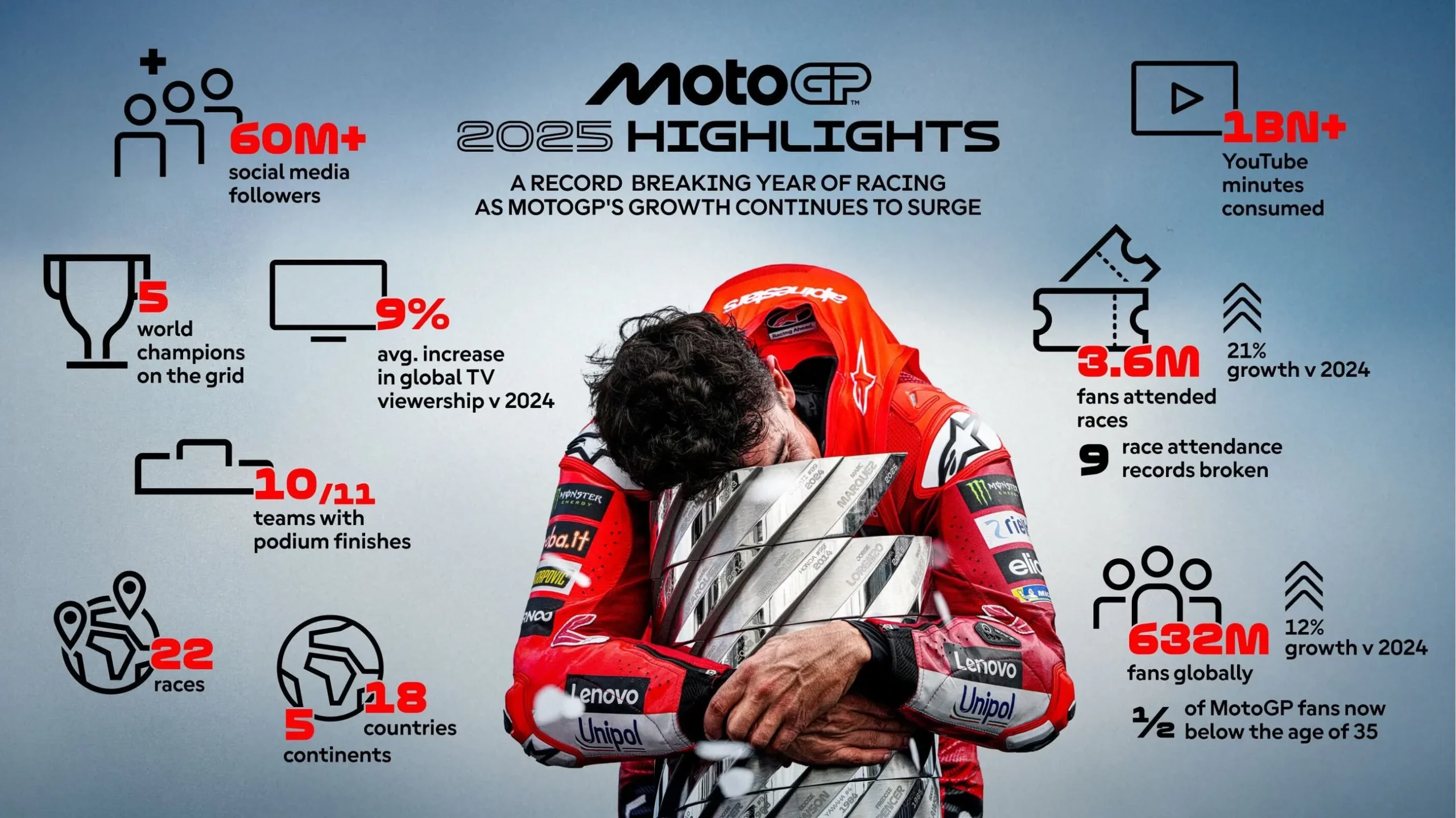
MotoGP has closed the curtain on another historic year of racing, marked by unprecedented growth, increased fan engagement, and milestone achievements both on and off the track. The 2025 season began with the launch event in Bangkok, and the implementation of a fresh brand identity, setting the tone for a year of innovation and progress. Across 22 races in 18 countries on five continents, MotoGP delivered its biggest calendar yet. Fans witnessed five world champions line up on the grid, 10 of 11 teams scoring podium finishes, and one of sports greatest ever comeback stories from 2025 MotoGP World Champion, Marc Marquez (Ducati Lenovo Team).
These narratives, combined with increased fan engagement activations and strategic efforts to grow the sport, fuelled remarkable momentum. The global fanbase surged to 632 million (+12% vs. 2024), while race weekends welcomed a record – breaking 3.6 million attendees. The season shattered nine attendance records, including an all – time high of 311, 797 at Le Mans in May – making the French GP the most attended race in MotoGP history.
TV audiences grew globally by 9% on average at each Grand Prix – with viewership for the Sprint s also jumping by 26% – compared to 2024. Meanwhile MotoGP’s digital presence continued to rise with social media followers passing 60 million. Engagement across those channels climbed to 61%, with fans consuming over 1 billion minutes of action on MotoGP’s official YouTube channel.
For the fifth consecutive year, research confirms that more than half of MotoGP’s fans and followers are under 35 – underscoring the sport’s growing appeal to a new generation. This youthful demographic is driving engagement across every platform, positioning MotoGP as one of the most dynamic and future – focused sports in the world.
Carmelo Ezpeleta, Chief Executive Officer of MotoGP, said: “2025 was a landmark season for MotoGP – a clear reflection of the work we have done to open our sport to new audiences and build deeper affinity with our fans . From record- breaking attendance to digital engagement and incredible racing on the track, this year shows the strength and vibrancy of our sport today – demonstrat ing the power of MotoGP to captivate fans and our partners around the world.”




[The story is as per press release]