The FIA shared details about track limits, DRS zones and more for this weekend in F1 Singapore GP, as the drivers weigh in on heat hazard situation.
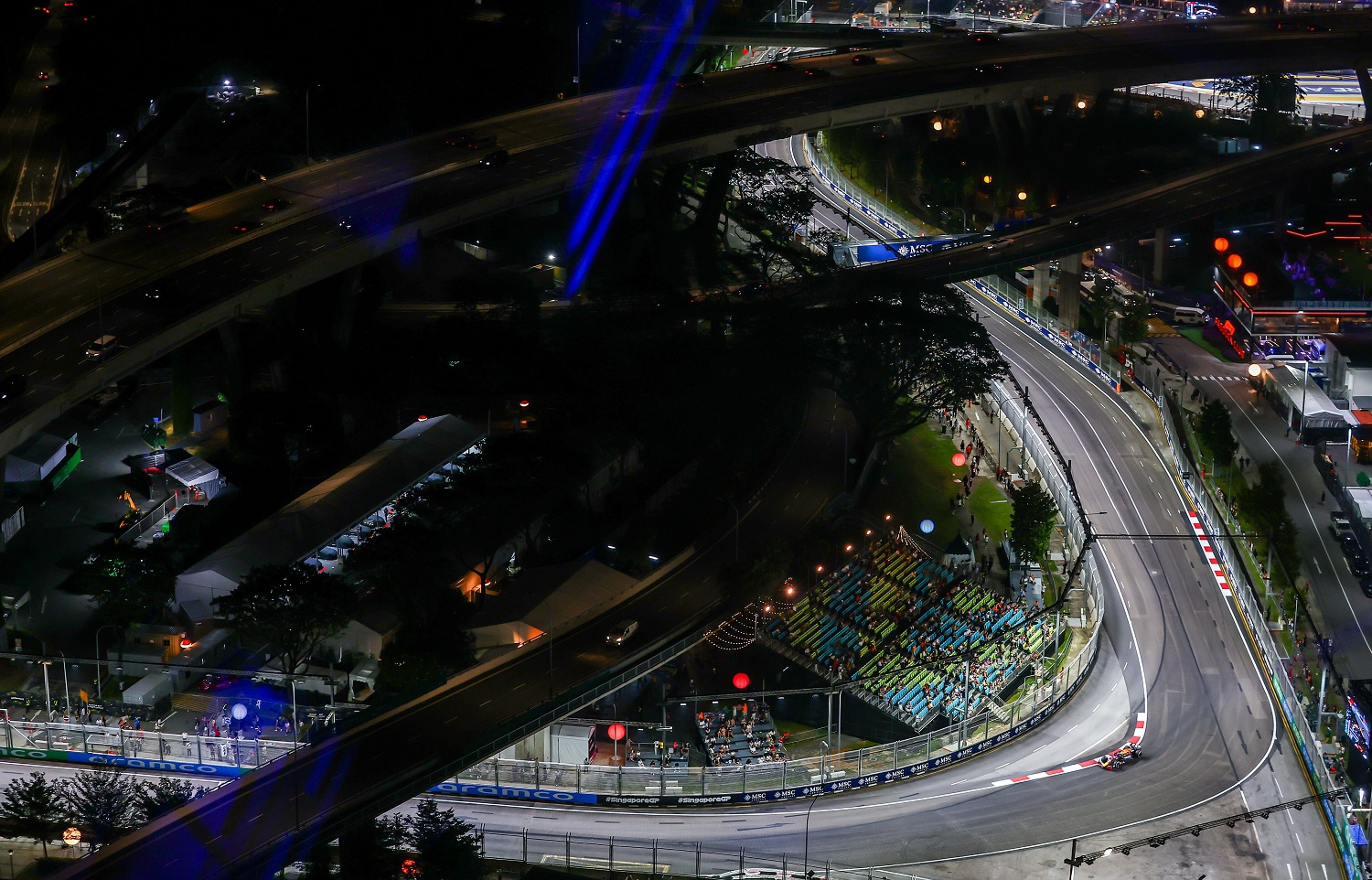
The track limits will remain the white lines as per FIA Race Directors’ note for this weekend’s F1 Singapore GP, but they added about Turns 18 and 19 which the drivers will have to negotiate properly – failing to do so will result in lap time being deleted.
“Additionally, each time a driver fails to negotiate the turns 18 and 19, will result in that lap time and the immediately following lap time may be invalidated by the Stewards,” said the note. It also stated that the run-off at Turn 1-2-3 will have to be negotiated properly.
“Any driver who fails to negotiate Turn 2 by using the track, and who passes completely to the right of the orange kerb/line element, must keep to the right of the red and white polystyrene block, and re-join the track on the outside of Turn 3,” it said.
The FIA also noted about changes made to the circuit from the previous event, they are –
- Resurfacing areas from Turn 2 until the exit of Turn 3.
- from entry Turn 6 until the exit of Turn 7.
- from entry Turn 9 until before Turn 11.
- from exit Turn 14 until the exit of Turn 16.
- from exit Turn 16 until the exit of Turn 19.
- Localized patching at Turns 5, 6, 13 and 14.
- Repair the edge of the working lane with the fast lane. The Safety Car Lines and Pit Entry lines are highlighted blue.
In terms of the four DRS zones around the Singapore F1 circuit, the detection of first is at Turn 4 while activation is 48m after Turn 5. The detection for second is 102m before Turn 13 and activation is 78m after Turn 13, while activation for third is 100m after Turn 14.
The fourth’s detection is 105m after the apex of Turn 17, while activation is exit of Turn 19. The FIA stewards panel for F1 Singapore GP will be led by Dr. Gerd Ennser, with the able support of Loic Bacquelaine, Derek Warwick and Paul NG.
In addition, the FIA noted that the weighing scales won’t be available for F1 teams to use from this weekend onward. “The FIA scales will not be made available for teams to use from this event onwards,” said the note. Futhermore, the heat hazard signal has been raised for the weekend.
The temperatures will be more than 31 degrees for it to be declared as such. It means the drivers will have to wear the cooling vest and if any of them will not, they will have to carry ballast to compensate for the extra weight of the cooling vests, which some may wear.
Here’s what some F1 drivers said –
George Russell: “Yeah. We’ve used the driver cooling vest a few times already this season at the hot races. But obviously, this is the first time where it’s become mandatory, which I think is good news. Not everybody finds the top comfortable, but I think some find it more comfortable than others. And of course, over time, you’ll be able to adjust it to your own preferences. But the concept is good. When you’re racing in 90% humidity and the cockpits are getting on for 60 degrees, it’s a bit of a sauna inside the car. So I think we all welcome it. I mean, I can’t talk for the other drivers.
“I think it’s just where the tubes on your back connect to the tubes on your front, and they have to go around your ribs. And when you go through high-speed corners and the g-force, you’re feeling these tubes on the side of your ribs. So I think that was definitely an issue for me at the beginning. They made some changes — it has been improved. But as I said, still, you have these tubes going around your ribs, which is not the perfect place for it. There’s not many high-speed corners here in Singapore and high lateral G-forces, so I don’t think it would be a major issue.”
Charles Leclerc: “I didn’t change my physical preparation for the weekend. Yes, we are doing… at least on my side, yes, I do things a bit more specific for Singapore, but my goal is to be as fit as possible from the first race to the last race. It’s not like I start training more for Singapore because I’m training as hard as I can over the season. Maybe you do some sauna sessions before Singapore, which helps acclimation with the heat.
“The only thing that changes with what the FIA announced is we now have the choice to run the cooling vest, which is something we’ll consider and keep in mind throughout free practices in case it’s way too warm in the car. I don’t expect this weekend to be harder than last year, and last year was very warm and very tough, but it was still doable. It’s something I will keep in mind for sure.”
Isack Hadjar: “Very well explained, Charles. Copy paste.”
Alexander Albon: “I think it’s a nice thing that we’ve got a choice at least to use this cooling vest or not. Different teams have different solutions, and within the cooling vest itself there are different ways to make it work. I don’t see it as a bad thing—and I think it’s safe. It’s a good thing; it’s another step forward in terms of making all drivers comfortable. It’s likely I’ll be using it for this weekend.
“As a team, Williams, we started using it early last year, experimenting, so I think we’ve got a good grasp of how to make it efficient and work for us and make it comfortable. In terms of preparation, it’s not like I’m taking the cooling vest in the sauna with me—still preparing like normal. I work a bit more than maybe other drivers on it just because I feel the heat quite a lot.”
Liam Lawson: “I think that would be probably mandatory to have the system in the car, I don’t know if we are made to use the actual cool suit, so at this stage, personally I won’t be running it unless we are forced to. But I don’t think we should use it. Personally, I don’t like it too much, yeah, it is not the most comfortable but I think at the same time, we have spent a lot of time training to drive these cars and we should be able to drive these cars as hard as they are, without…I think at the same time we have, if it fail, it will be much worse for whatever reason, I don’t think at such degrees it does fail, I don’t about other categories but of course if it fails, it will be very-very hot, so yeah.”
Lewis Hamilton: “I’ve never used it, but I’ll try it. It’s quite uncomfortable. It itches a lot — not sure I want to drive with an itchy top on.”
Fernando Alonso: “I have been using it in couple of FP1s, basically in preparation for this race or Qatar. I think I plan to use it on Sunday, it is going to be first time in the race. I only used it in free practices so far, I don’t know it is an open topic for us. I think the system works. The shirt itself, the material is little bit thicker of the system on it, so it is less comfortable, so it is a trade-off. It is less comfy when you drive it but it is little bit cooler, lets see how it goes.
“It should be fine for the length of the race, at least for one hour of free practice it keeps working the same from minute one to 60. On that regard it is okay, but for me, it is more the comfort side of it. I have been driving well with the shirt on but with the system off, just to see how it feels and it is more a position thing with the belt something than more the heat of the shirt.”
Carlos Sainz: “I think there is combination of heat and humidity. I think it can be 29 degrees but the humidity gets the real feel inside the car and out here at much higher level of perception. So, I think it is those two values when you have a map together that triggers the possibility to run the vest. I think it is fair to be honest, only hot is not too bad for us, we have that…for example in Hungary, it gets really hot, it is not humid. Humid on its own is not too bad at all when it’s not too hot but when it’s 28-30 degrees plus humid, that’s when it gets to Singapore level, it is tough. I think teams are managing to work it better and better when we run it.
“At the beginning, we had it to work more or less for half an hour, I think hopefully now, the whole system can work at least for an hour, it is a two hour race. Again, I have done 10 times Singapore, if it breaks, I am not too worried, I’ll race and jump our fresh, like I always do, if it works then it is better, then you suffer a bit less. So, lets see. I think the problem if you do that…if you want to switch it down, it already doesn’t work because it is warmed up. I agree with you because we do the ice baths, we do everything, maybe you don’t need at the beginning, you need it at the end but maybe at the end, it doesn’t work, so we will see. We will maybe test it and see what we do with it.
“I wasn’t expecting system to work flat out this first year and then like always in F1, engineers and providers, they get working at it and they find solutions and that’s how F1 works. Not as comfortable without them [the vest], but it gets to a point where in the stint of the race you are, you don’t realise that you are working it anymore, so it is good enough that you are not noticing it enough at all times…to jump in, to jump out, just do the click, it is not a mess but unconformable but during the car, you are focused, you don’t remember you need it. I did the first try in Jeddah and we were working on it, it was almost like not wearing it, maybe it worked 15-20 minutes.”
Nico Hulkenberg: “It is declared for it, so we have to use the ballast anyways but you might as well take the thing. I think we haven’t had it properly and actually running yet, so we need to verify and try out and sign it off but if it is a…I’ll yeah. After Jeddah, I was toast after the race, it was bloody hot and I had Alex next to me in the plane and he ran the thing and he looked fresh like a spring chicken, so I said next time I am going to run the thing.
“We tried in practice sometimes but it didn’t…the functionality wasn’t 100%. For me no problem, I had no issues with that. Ideally, the last time when there was a problem, there has been work done to it, so hopefully it is just up and running now but we got to…obviously we haven’t used it in a while now, because it wasn’t the topic, now it is, I am sure we will figure it out.”
Lance Stroll: “I am going to try and wear it, to see how much comfortable it is. I haven’t tried it yet. Fingers crossed that it works and I can get a couple of degrees [lower]. I think Singapore, it’s one of those races where you can prepare for it in every way possible. Heat training, sitting in saunas – I sat in a sauna all week, just doing what we can. But from my experience, no matter what you do, it’s always a brutal race physically, mentally, with the challenges of the track, the walls, no room for error and just the cockpit, the heat in the car, insanely high temperatures.
“So yeah, I’m going to try the vest, see if it works. But I think no matter what, maybe it only works for five laps and then you have no more cooling. Then it’s just 50 laps of suffering. It is just Singapore, that’s the weekend. It is the glamorous life of Formula 1 that no one sees behind the scenes.”
Pierre Gasly: “I think I’ll try, I tried earlier this year in Saudi. I think we will try to make sure it works in case if we want to use it, but I like the flexibility of it. Actually the choice of if you want to run it or not. I tried it only in practice in Saudi. It worked for some laps. I think ultimately it doesn’t harm you, so I think it is more like a preference and if you feel for it, if it is like that you run it, we will see what conditions we are there.”
Franco Colapinto: “I haven’t tried that in the car yet because the thing was earlier in the year in Bahrain, those tracks they tried out in the test, so I haven’t actually tried it myself but I think as far as it stays that something optional for the drivers that when it is on record and heat declared, we can choose it or not, depending on our fitness and if we really struggle or not, it is fair, I think it is fair on the part that you need to put more weight or less weight and use the vest, so it stays very fair.
“I think there should definitely be an option for drivers to use or not, depending the situation, should be very open. It definitely helps when tracks are hot. I think this one is very hot, I don’t know how it will develop over the 90 minutes race if it at some point it starts to become little bit hotter, I am not really sure, I haven’t tried it. I think here can be a good test to see how it works.”
Gabriel Bortoleto: “I tried it very early in the season in Bahrain. It worked very well for me, I know lot of drivers had problems but for me, it worked pretty well. Hopefully…I don’t know it will be mandatory to use, is it? So, lets see, if it too hot after the first session, then we use it.
Oliver Bearman: “I think I tried in Budapest last time in FP1, but for us, it is working okay, comfort wise it is not the best but I think by way of overheating, it is uncomfortable with the few tubes to keep me cool, but I guess it is going to be beneficial, [but] of course we need to run it in FP1 and FP2 and see if it actually stays cold. The only issue is that if it melts too fast you’re just circulating hot water and then it’s probably heating you up more than just not wearing it. That’s the trade-off.”
Here’s full FIA Race Directors’ note: https://www.fia.com/system/files/decision-document/2025_singapore_grand_prix_-_race_directors_event_notes_.pdf