The FIA has informed of some changes approved on F1 side in the ongoing WMSC meet in Tashkent, with regards to testing and simplification in different sections.
With the completion of the 2025 F1 season, the FIA has got together in Tashkent for the World Motor Sport Council meet where it will also hand over the winning trophies to Lando Norris and McLaren on Friday, along with other champions and co-champions.
Before the D-Day, the WMSC met to discuss various topics related to F1 and approved changes after discussions. The approval to divide different regulations has been agreed upon, with six sections designed to make things all the more simple to monitor. They are –
Section A: General Regulatory Provisions
Section B: Sporting Regulations
Section C: Technical Regulations
Section D: Financial Regulations (for F1 Teams)
Section E: Financial Regulations (for PU Manufacturers)
Section F: Operational Regulations
Among the key changes, the single pre-season test running will return in 2027 after approval of three sessions to prepare for new regulations in 2026. A provision will be made to extend FP1 session during sprint weekends in case of red flags to allow competitors with enough time.
Here’s a list of approved changes – includes technical changes:
- Sprint Qualifying dry tyre limitations will no longer be removed when a period of Sprint Qualifying is declared wet.
- The operational personnel limit for 2026 will temporarily increase to 60, to ensure teams can operate the new generation of cars effectively.
- Race suspension and resumption procedures have been simplified.
- The return to single pre-season test from 2027 onwards has been confirmed.
- Out-of-Competition Tyre Testing car specifications have been amended as necessitated by the generational car change for 2026.
- An allowance has been made for FP1 at a Sprint event to be extended following a red flag, to ensure that competitors are afforded relevant practice time.
- There have been updates to Driver Adjustable Bodywork (SLM / CM) usage – these amendments have been made to ensure congruity with Technical Regulations, as well as finalise details of SLM usage in several scenarios.
- Minor changes to Article C3 for clarification, including those related to deflection tests procedures.
- Changes to the power unit regulations were made to refine the energy management provisions.
“For the first time in 15 years, there was a three-way fight for the championship decided at the final race – and what a race it was,” said President Mohammed Ben Sulayem. “This year-long battle was a fitting end to the current regulations cycle, as we look forward to the significant changes that will come in 2026. The new technical regulations we have discussed and approved within this Council will deliver safe, sustainable, and thrilling racing. Thank you to all involved with this process that will drive Formula 1 into a new era.”
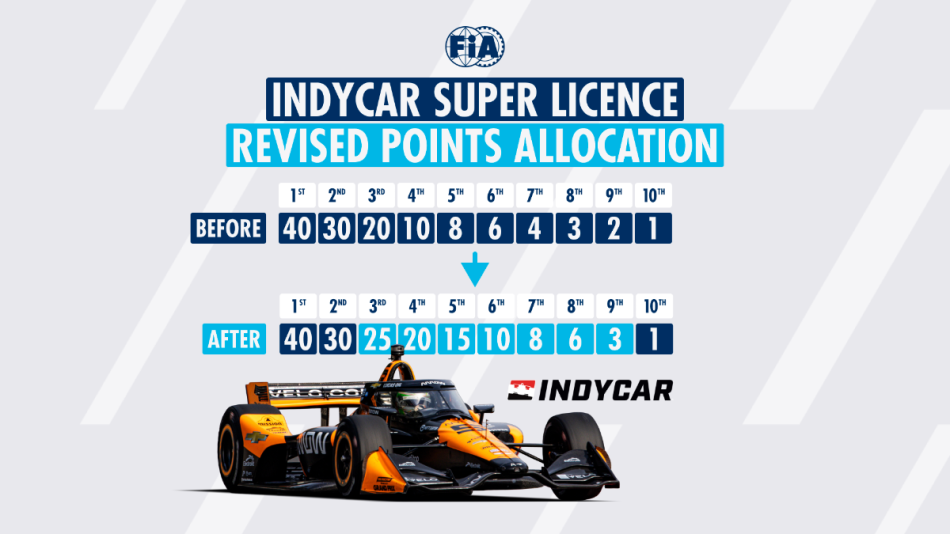
Additionally, the FIA has approved revision of points awarded to Top 10 finishers in America’s IndyCar competition to attain F1 superlicense. The lack of points when compared to F2 came to light when the likes of Colton Herta, Pato O‘Ward and Alex Palou tried to make a switch early in their career.
While O’Ward and Palou seems to be satisfied racing in IndyCar, Herta has made the step outside in association with Cadillac F1 Team. The American will compete in F2 in 2026 with Hitech GP to attain enough points to secure a valid superlicense to compete at the pinnacle in time to come.
The revision will see everyone from P2 to P9 gain more points than before. The winner will continue to earn 40 points, but from P2 to P9, it will be 30, 25, 20, 15, 10, 8, 6 and 3 as opposed to 25, 20, 15, 10, 8, 8, 6 and 3.
Here’s Pirelli on new F1 tyre range