


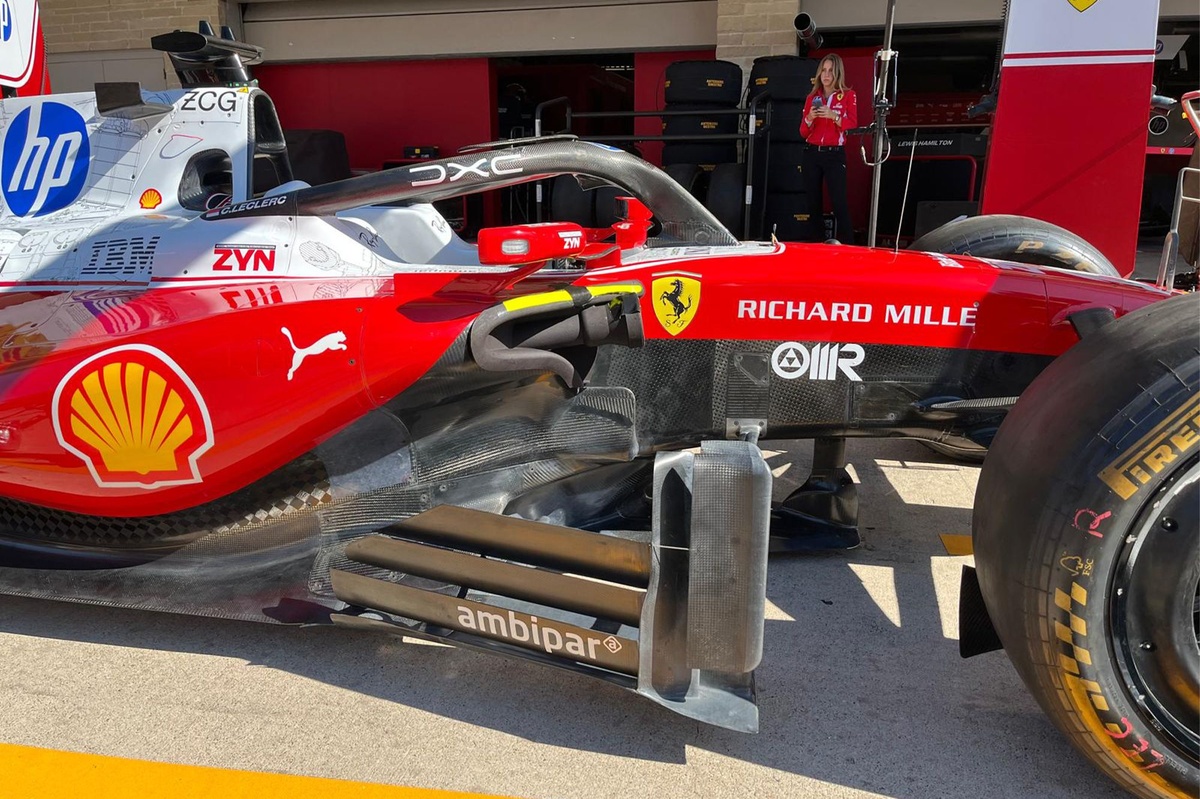
Ferrari has introduced a new set of updates for the United States Grand Prix of Formula 1, with an innovative focus on the elements located at the front of the floor of its cars. Despite the new additions, both Lewis Hamilton and Charles Leclerc have minimized the importance of these changes.
The SF-26 model has undergone a slight restructuring at the sidepods, with minor adjustments to the inlet hole and a small modification to the undercut in connection with changes to the floor table. According to the technical notes before the event, the aim of these adjustments is to increase the energy of the airflow circulating towards the rear of the car, seeking to make the diffuser function more effectively.
Additionally, the diffuser has been updated to increase the expansion of the airflow released from the rear. This modification involves adjusting both the volume of the diffuser and making small improvements to the internal bars of the floor.
The five elements that control the airflow under the floor, referred to as ‘fingers’, have been expanded. Specifically, Ferrari has extended the outermost element to create a horizontal flow conditioner, thus improving the quality of airflow in this critical area.
Despite these updates, Hamilton has made it clear that the improvements are of little significance, pointing out that the car’s performance will prioritize its adaptation to the Circuit of the Americas over the improvements made. Leclerc has also commented that, while they are steps in the right direction, the improvements are not as drastic as had been speculated.
‘These are not major updates; I’ve heard plenty of comments, but they are not as relevant as one might think,’ Leclerc stated. He also added that they hope to see if these modifications could help improve performance and win races.
During the first practice session in Austin, Ferrari showed a good pace, with Leclerc setting the best time, although a lap time from Max Verstappen was canceled for infringing track limits.
The question arises: why introduce updates that only provide ‘less than a tenth’? If Hamilton’s approach proves correct, the investment in these improvements may seem disproportionate. However, beyond the surface numbers, an increase in airflow towards the rear can translate into more consistent aerodynamic load levels.
These improvements may not drastically change the lap time, but they should ensure greater stability in aerodynamic performance under different speed conditions. Moreover, the update can serve as a foundation for future innovations for the next season, where the number of ‘fingers’ on the surface will be reduced from five to three, a measure that could impact the profitability of the current improvements.
Written by FormulaRapidaAI
SourceID: SRC_a84824684b56082f31e77d76b2175f0f4340e226