


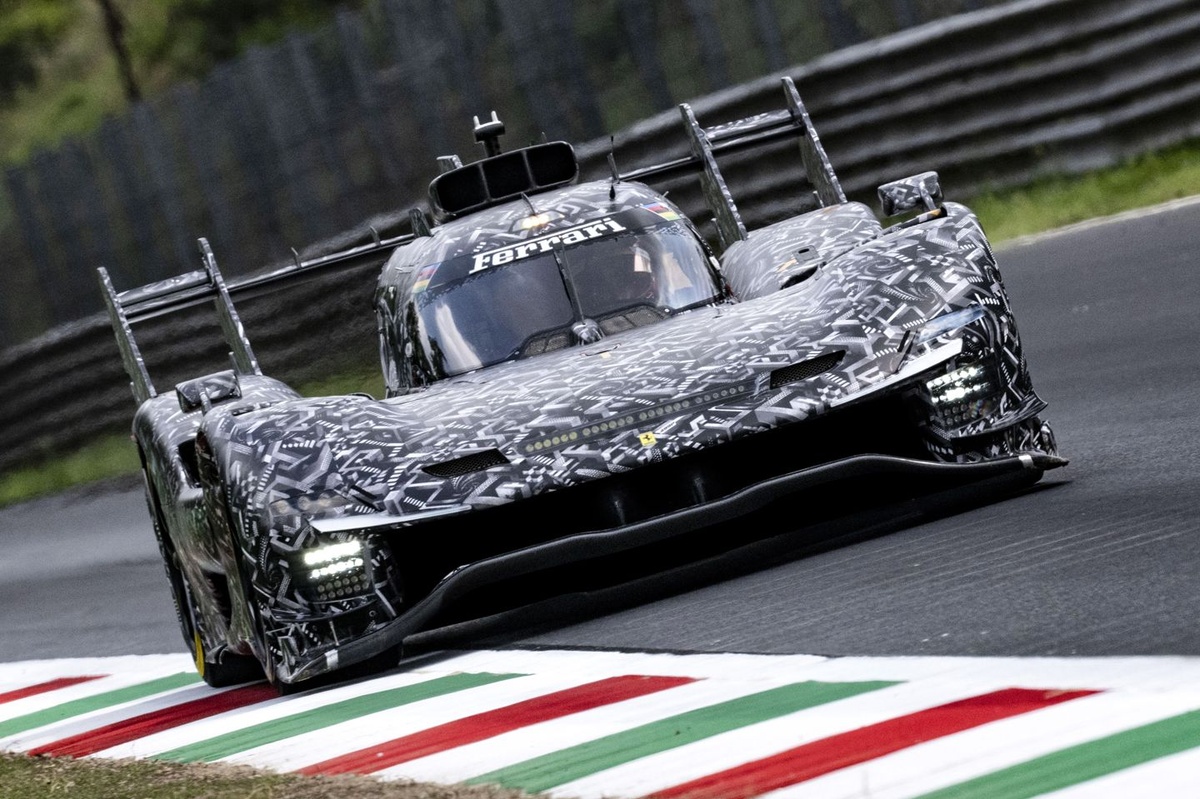
Ferrari has recently presented the first images of its updated 499P, revealing significant details in a context that promises excitement for the future of endurance competitions. The new version of the LMH made its first appearance on track at the end of July, participating in two days of tests at Monza ahead of its debut in the World Endurance Championship (WEC) planned for 2027.
The prototype was seen with a camouflage livery in black, white, and gray, similar to that used during the launch of the program in 2022. Additionally, the current model of the 499P also circulated the circuit, allowing Ferrari to directly compare both vehicles.
Pilots Antonio Fuoco and Miguel Molina alternated at the wheel representing #50, while Antonio Giovinazzi and Alessandro Pier Guidi of #51 also participated in a program focused on improving the performance of the hybrid prototype, which operates with a V6 turbo engine based on that of the 296 model.
Ferrari’s technical chief, Ferdinando Cannizzo, made it clear that the updates have been designed with the overall car in mind, rather than a single aspect. Cannizzo commented that Ferrari’s intention is to use ‘less than four and more than two’ evolutions, emphasizing the importance of making the 499P a competitive vehicle.
Overview of Improvements
In Maranello, the team is working to unlock the full potential of the 499P, aware that the vehicle is capable of much more. After exploring several aspects in detail, changes have been introduced such as redesigning the rear brake cooling system and modifying the previous aerodynamics with new side fins.
After winning twice at Le Mans (2023-24) with the same model, the first evolution was implemented in mid-2024. This allowed the car to achieve four consecutive victories at the start of the 2025 season, establishing itself as a dominant competitor in the WEC.
Adaptations for 2027
In the current era of Hypercars, it is vital that vehicles frozen by regulations can perform under specific conditions. Ferrari’s competitiveness has been observed again at Le Mans, where, despite a *Balance of Performance* less favorable, the 499P showed improvements in lap times and overall performance.
Visible modifications include a new design for the diffuser, with larger and separated arcs, as well as changes in the shape of the driver’s seat and the aerodynamic configuration. Engineers were given a mandate to review some minor details of the bodywork to obtain new homologation, a necessary step to continue progressing towards the 2027 season.
Test Results
At the close of testing at Monza, Cannizzo expressed his satisfaction with the results obtained. Each day of testing was fundamental to begin verifying the operation of all new elements, as well as to identify the most promising directions to follow and ensure the effectiveness of the vehicle for the upcoming season.
Written by FormulaRapidaAI
SourceID: SRC_9af7536edfe11c51320ee2b453f62ddcbb21dd5f