


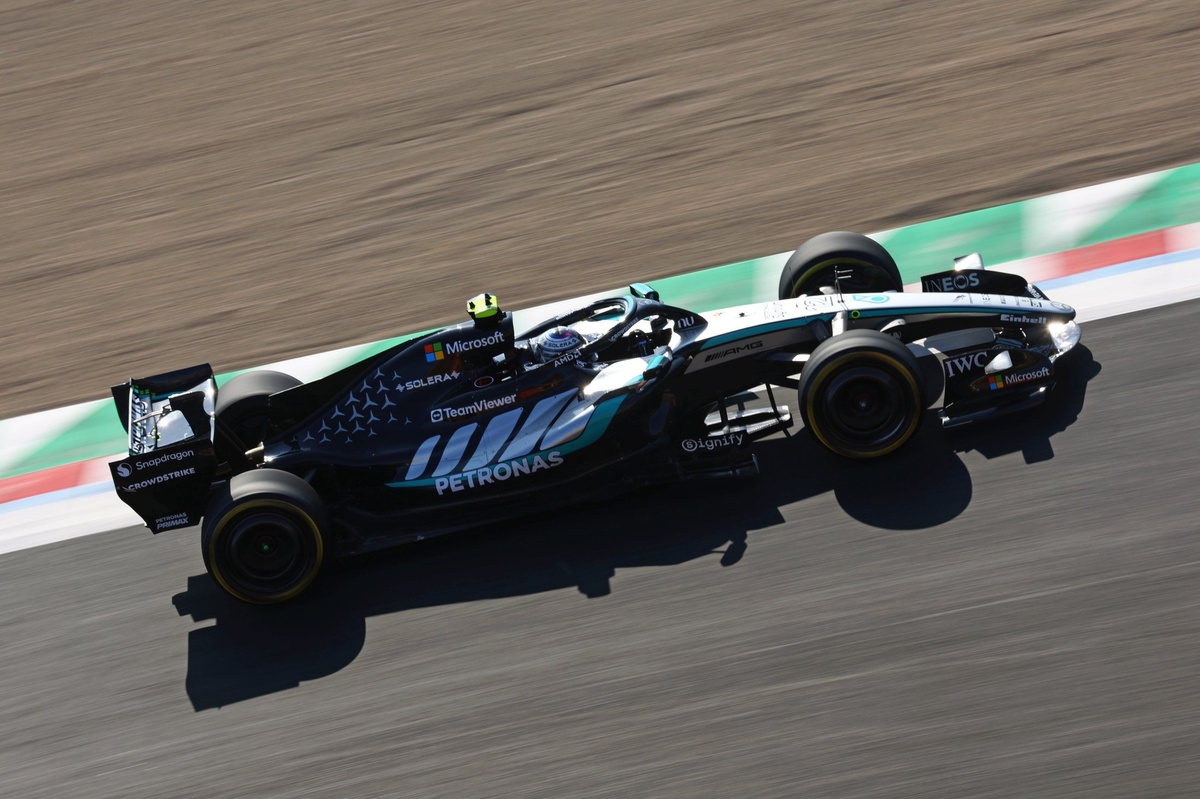
The new generation of Formula 1 monoplaces has transformed the way drivers approach the first sector of the Suzuka circuit. With a reduction in ground effect, speeds in the corners have decreased significantly, and drivers now hardly use the brake pedal. This is due to the hybrid system that decelerates vehicles during transitions to maximize energy recovery in a key section of the circuit.
Over the years, Suzuka has captivated both drivers and fans thanks to its spectacular layout, which combines medium and fast corners. However, the incorporation of new engines has radically changed the challenges of this track, notably altering the driving style at Suzuka, perhaps more evidently than at other circuits.
Changes in Driving Format
One of the key reasons for this phenomenon is that the Japanese circuit does not have many areas of intense braking, which limits battery recharge opportunities during acceleration phases. Some of these phases cannot even utilize DRS for safety reasons. Because of this, the FIA has decided to reduce the maximum recoverable energy from 9 MJ to 8 MJ during qualifying.
With this change, the aim is to decrease lift-and-coast and super-clipping maneuvers, but it is clear that teams must maximize the 8 MJ available by identifying the best recovery strategies. A notable aspect is the entry into the Esses, where significant speed differences between teams become apparent. It is not just about ground effect but also about the amount of energy used at the exit of corner 2.
Driving Styles and Hybrid Systems
This year, monoplaces generate less aerodynamic load, which has made it difficult to maintain the same pace, especially in medium and fast corners where the ground effect design previously excelled. Additionally, the new power system has changed the focus on the track, as had already been anticipated with the introduction of only two activated aero zones.
Thus, drivers adopt diverse strategies: some conserve energy for later phases, while others opt for a more aggressive approach, using more energy from the start to achieve higher speeds. This change in strategy has been facilitated by the fact that the MGU-K is being used as a genuine braking device, not only to reduce speed and diminish understeer but also to recover energy.
Teams that previously had high aerodynamic load, such as Red Bull and McLaren, tend to rely less on brakes. In contrast, Ferrari and Mercedes, which have a certain deficit, must actively use the brake pedal to compensate for the lack of front grip, thus aiding vehicle maneuverability during entry and mid-curve.
For example, using Ferrari as a reference, it is observed that in this section the brake pedal is barely touched. The MGU-K handles most of the braking work, facilitating rotation without the driver needing to press the pedal. Sections that were previously taken in sixth gear are now approached around 30 km/h slower, in a lower gear and with less throttle, while maintaining high engine revs.
Work Inside the Monoplace
The FIA has established that between corner 3 and corner 6, power reduction can exceed 150 kW, meaning that, in some areas, the MGU-K does not deploy power even though the driver is accelerating. This is due to the limiting factor not being engine power, but grip and aerodynamic load. This allows drivers to save energy for later sections, resulting in vehicles that exit corner 6 with more energy than at corner 3.
Ultimately, this new approach to driving at Suzuka does not drastically alter the driver’s instinct in terms of throttle modulation, but completely transforms what happens under the hood: the electric motor is used differently, almost completely replacing mechanical brakes. As Sainz commented, “it’s not a disaster, but it’s not like before. F1 shouldn’t be like this.”
Written by FormulaRapidaAI
SourceID: SRC_137d640c8c4a092e25da584e74f02f355bedb8d0