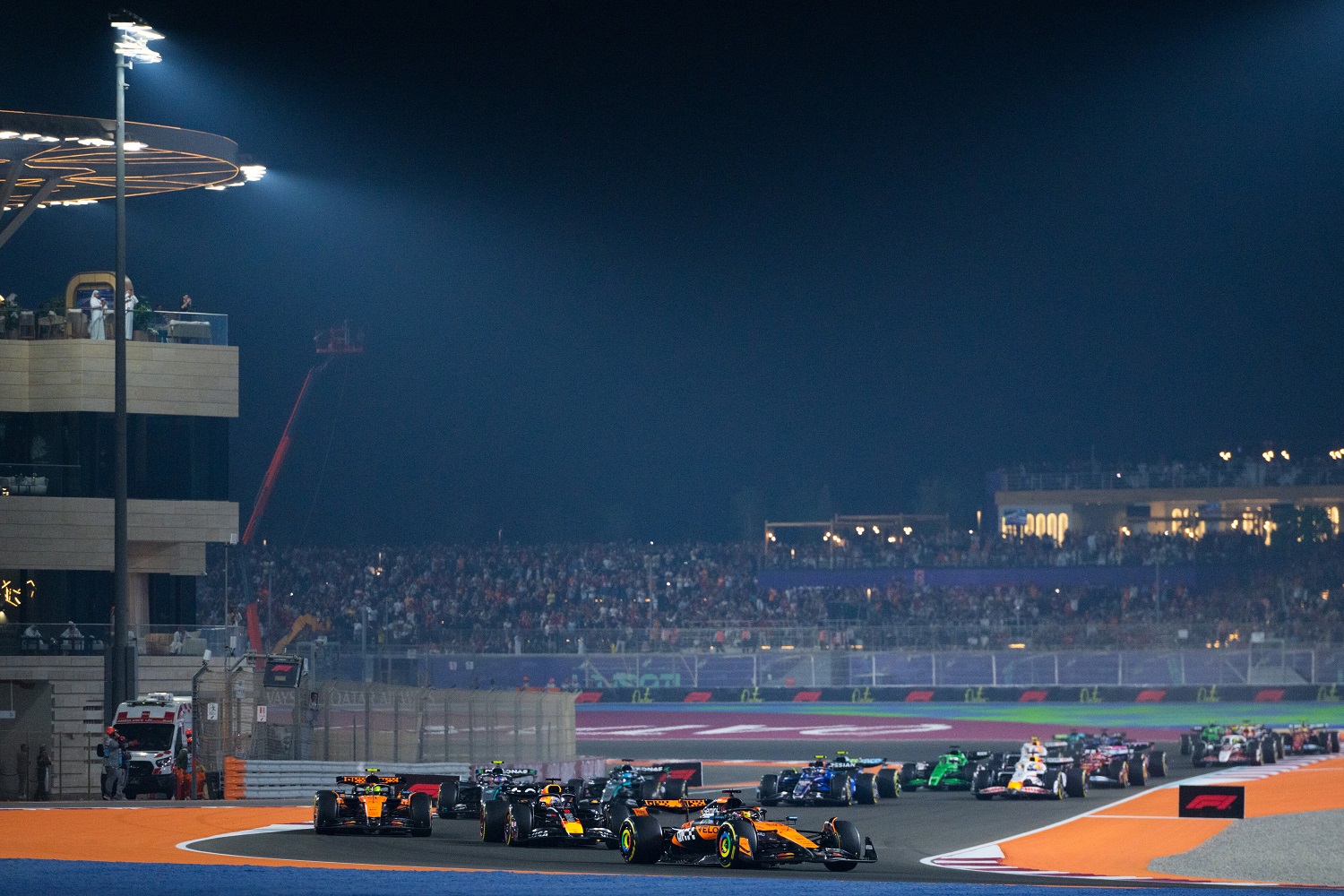
The F1 drivers and couple of team bosses share first thoughts on the drivers’ meet in Qatar to discuss the guidelines and how the FIA can improve on stewarding.
The big drivers’ meet took place in Qatar on Thursday where all the 20 drivers were present alongwith officials of the FIA to discuss on the driving guideline and how they can improve on it. They went in detail about five incidents from the 2025 F1 season as shared by the governing body.
The meeting went on at length with proper dialogue between the two parties. The FIA identified few key pointers where they can bring about changes from 2026 onward. It was positive as per some of the F1 drivers, as they highlighted when asked by the media.
They key discussion remains how they implement the said guideline, which is not a regulation but a mere document to guide the stewards and not force them to apply the same way. This is where the inconsistencies have happened for most part of F1 2025 season.
Here’s the initial reaction –
Oscar Piastri: “Yeah. I mean, I think it was very productive. I think it’s good to always give out direct feedback to the Stewards. I think [it was] tidying up a few things. I think generally things have been pretty good. Whenever you try and put any kind of guidelines or wording around going racing, there’s always going to be gaps somewhere. It’s impossible to cover everything. So, I think just some ideas and opinions on how we can close some of those gaps was good. So yeah, I thought it was productive.”
George Russell: “Yeah, definitely productive. I think from the incidents that were shown, all of the drivers agreed what the penalty either should have been or lack of penalty. And yeah, like Oscar said, the general consensus in the room is: if you put these guidelines in place, they absolutely have to be guidelines. Every track is different. Every overtake is different. Every circumstance is different. Sometimes you’ve got to use that racing knowledge that, as drivers, we’ve all accumulated over 20, 30, 40 years of our life. And the Stewards – the driving standards Stewards – sometimes have to judge it based on the common sense of racing, as opposed to exactly what a guideline says. Otherwise, you may as well have a lawyer dishing out the penalties. So yeah, hopefully we can migrate more in this direction.”
Esteban Ocon: “Yeah, it’s more about racing and it’s great that we have conversations with the stewards about what to do moving forward. We are building our sport basically with what we have to say, which is fantastic. So, I’m glad that we are all having an open conversation like that. This [the race start movement] is completely different topic, obviously now. So yeah, we’ll see about next year.”
Gabriel Bortoleto: “Let’s say, we give opinions of what can be better and they try to listen and try to implement. And yeah, I think that how was the meeting was a bit like this, you know, they ask, they show a bit of some incidents and we talk about them and we say, look, from this point of view, it shouldn’t be this decision or that. It’s just a bit of a discussion, you know, like if you sit at the table and you discuss about something with someone. I think so, yeah. I think there is always improvements to be done. I think drivers will always complain because that’s how we are and there will be always things that we believe that can be better. Because there is always different opinions and views of things, and yeah. But I definitely believe they are going in the right direction. No, I don’t think there is different opinions.
“I think from all the drivers, we were very aligned on what do we believe that things that they should, in our view, follow the driver guidelines. I don’t think that it was too much on the line to follow, let’s say like this. And then we created a couple of penalties that maybe they were not supposed to happen. Yeah, it’s not that you cannot use, but you need to be sensible. So like, for example, when you lock up, it means that you are out of control sometimes. But something that they mentioned, the drivers, it was not me in this case because I didn’t put my opinion in that specific situation. But I think we all agreed on that, that there is some tracks that unfortunately, they are cambered, not unfortunately, but like they are cambered or something. And then you brake and then, you ended up blocking the wheel. But just because of the way the track is made, but not because you’re out of control or sometimes because you’re actually trying to avoid a crash.
“And then because, the guy in the outside starts, just going into the corner like if you’re not there. And then you need to just hit the brakes even harder to try to avoid the crash. You lock up and then you crash into someone. And then you are the one to get the fault of it because you locked up. And that’s what the guidelines say. But sometimes you’re just trying to avoid something. So what should we do in that situation? Just release the brakes and destroy the guy ahead? And well, you didn’t lock up, so you’re not out of control. And that’s the discussion we had. There was no, let’s say, this is right or this is wrong. But we just put things on the table for the next time the situation like that happened, maybe being a bit more open-minded of why did the lockup happen or something like this. But we didn’t discuss only about that. There was other topics as well. I don’t know [of changes]. Because I don’t know if they’re going to change it or not. I think it’s up to them to make the change. But I think mainly the way that they review maybe the incidents and how they see them, maybe not following 100% of the guidelines. Because guidelines at the end of the day, again, they are not rules. They are things that can guide you to take a decision.”
Frederic Vasseur: “I think we are all a bit schizophrenic. We want to have consistency – that means in this case, you need to have guidelines and to follow the guidelines. But at one stage, we also want to introduce a human factor able to judge – not just to follow the guidelines. At one stage the situation becomes difficult. This is also coming, I think, compared to the past, from the fact that the field is closer probably, and we have more often these kinds of situations.
“But I think to keep a human factor in the decision makes sense. Because it’s not just about having the wheel nut one millimetre in front of the mirror or below the mirror – for the drivers, it’s very difficult to assess whether they have the front axle ahead of the mirror or not. Honestly, it’s quite impossible when you are in the car. At the end of the day, having a human factor is important. But we have to accept that the decision can be a bit different if it’s not just a mathematical approach.”
Steve Nielsen: “Yeah, I’d agree with Fred, honestly. OK, I’d mostly agree with Fred then. [laughs] No two situations are the same. And as Fred said, there’s always going to be a human factor. I think this is a sport that wants to measure everything to the nth degree and have an exact science. When you have human judgment involved, there are going to be variations. I think we just accept that as part of the sport, to be honest. There’s always going to be differences of opinion. It’s not only in this sport – it happens in other sports as well. And I think we just trust in the FIA. They’ve got fine people doing it, and we’re happy with it.”
Here’s note from FIA on the meet