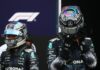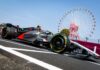

F1 drivers discuss about the spray issue which has hampered racing in wet conditions, as they note how the asphalt, tyres and ground effect cars has made it more difficult.
A lot of the races in F1 2025 has taken place in wet conditions or at least mixed weather conditions. The FIA Race Director has had to take key decisions in the context of when to stop and when to re-start or continue. Certainly, it isn’t an easy job to satisfy the drivers, teams and also the fans.
The latest case which led to the current debate stemmed from the grand prix at Spa-Francorchamps. The Race Director waited for the rain to subside and literally start the grand prix under dry conditions. It was a conservative approach, something that was already discussed aftermath Silverstone.
Additionally, the history of Spa-Francorchamps was taken into context as well. The previous incidents led the Race Director to be a bit cautious despite the safety improvements. One if the biggest troubles in the current era has been the spray thrown by the F1 cars in the pack.
The larger tyres and ground effect mechanism has led to larger chunk of spray, where visibility is bare minimum unlike the cars of old where there was enough for the races to continue. The asphalt is also a pointer where the grip levels drop hugely in wet conditions.
Here’s set of F1 drivers discussing about the issues and what can be done –
Pierre Gasly: “It’s always easier to explain why you’ve been too conservative than explaining why you’ve put the drivers in dangerous conditions. At Silverstone, we saw a driver hitting another car from not seeing where it was going, which to me has nothing to do with racing. We want to see overtaking. We want to see skills out there in the wet, not a race decided on whether you see what’s going on two meters in front of your car. Spa, they said before the weekend, they’d probably be more conservative knowing what happened in Silverstone and knowing the history of the racetrack. Were they on the conservative side? Yes. Can we complain that they were conservative? I don’t think so. Can we work with them to help them make a slightly more precise judgment and increase the show and the driving on track in these conditions? Sure thing. I’m sure we’re going to talk about it in the Drivers’ Briefing and next race they’ll do even better and we’ll find the right adjustment. I don’t think it’s fair to say they’ve done a bad job.
“It’s explainable. They were on the safer side this time. We’ll work on that. Us drivers, we want to drive on the wet. We’re fine with it. It’s always exciting. You don’t want to end up in a situation where you don’t see and you end up crashing in the middle of the Kemmel straight and having another incident you need to explain to another family. It’s a fine line and we will work on it with the FIA and I’m sure it’s going to get better over time. We know the spray is definitely not great with these cars. There’s been quite a lot of testing going on to reduce the spray from a tyre point of view, like a wheel cover, etc. I’m not too sure where we are at, but moving forward, we definitely need to find a way to reduce that spray, which then will allow us to race in wet conditions. At the moment, when the visibility is fine, there’s no need for the wet tyre. It’s a bit of a chicken-and-egg kind of thing and they need to work on that.”
Esteban Ocon: “I can give an example. The first year I went to Spa was 2012 and I was at the back of the grid. It was a wet race. I couldn’t see a thing, basically similar to what happened to Isack when he crashed into Kimi, except we were in Spa. I was P25 or something like that. I tried to look to the right to see if there was some clear vision ahead and no spray, and I backed off. I was maybe in fourth or fifth gear, probably like 160, 170. The moment I pulled to the right, I basically crossed the car that was parallel to the track and I just saw him when I crossed his path. If I was on the left, things would have been similar. I would have probably had a massive injury from that. I’ve been in those situations. It’s not any fun. I think what the FIA did was the correct thing for Spa. We don’t want to race in conditions where we are not able to see two metres ahead. It’s calling for disaster to happen again. We’ve lost enough drivers in those kinds of conditions and that’s not something we want to see.”
Oscar Piastri: “In the last few years, we’ve been giving our feedback to the FIA about what we think is acceptable and what’s not. It is always much worse in the car than it looks on TV, and I think the FIA has done a very good job of listening to us and taking that feedback on board. We asked for them to be, if anything, on the conservative side. You could argue that we were, but we would much rather that than the opposite. The feeling in this room would be pretty different if we had a big crash last week. We’ll work with the FIA and fine-tune that, but I think we’re on the right side of cautious.”
Lance Stroll: “You mean like the conditions and stuff? I think the cars have gotten big, the tyres have gotten bigger, the spray has gotten worse over the years. That’s my feeling. Visibility is the biggest issue now with the size of the cars and the tyres. Races like Spa with the nature of the track, Eau Rouge, going 300 kilometres per hour without seeing anything at the top of the hill—racing conditions like that are hard to go through with and then go racing. I don’t know if it’s gotten worse. It’s always been challenging. The spray is the biggest issue and the visibility. To go ahead with races like Spa, start earlier and race in proper wet conditions, we need to work on the visibility factor and how we can improve that.”
George Russell: “Yes, I do not know, to be honest, you would have thought with all of the technology we have now, with GPS, with heads-up display, having your road cars at home, that there could be some sort of system to visually show the car in front of you, when you cannot physically see that car, it is the same as when you are driving on the highway at 130 in the rain, and you turn your wipers off, that is what we see. But the difference is we are doing 300, not 130, so maybe the future is some sort of virtual reality, I do not know, not virtual reality, but some sort of heads-up display showing where that car is. I do not know, I am not intelligent, and it is for the smart people to come up with the solutions.”
Oliver Bearman: “Probably F4 [I raced in race with poor conditions due to rain], before you put the diffuser on the car. Once the diffuser comes then it’s quite difficult to have good visibility in the wet. It’s the problem, it’s the age-old problem. I think it will never change. It’s not a case of full wets or inter-tyre, it’s just the level of the water on track. I think the good thing was at some places on the track, like the straight before Eau Rouge, there’s some grooves cut in the track now for drainage and that was actually very good for drainage. So, if they could have that in the straights, that’s where all the issues come, in the straights at high speed, if they can drain the water with those grooves in the straight line then maybe it would be beneficial, I’m not sure.
“But yeah, I think we’re always going to struggle with this issue of visibility in the wet, especially now with these ground effect cars. Yeah, that’s the thing. If you look back then, the wake of the car was much more concentrated and thinner. So behind the car, it’s twice the width of the car, the spray behind it. Now it’s like three or four times. The spray is enough to cover the entire circuit and if you can’t see, sometimes, I’m driving down the straight and I can’t actually see anything and that’s when it gets a little scary. Even if you can just spot a brake marker or a tree on the side of the track to kind of see where you are on the track, it already helps. But when the spray is just so dissipated and everywhere, it’s really tough. I don’t know [about 2026], I don’t think so [much will change]. I mean, it’s just life. F1 downforce equals a lot of spray. It’s just part of it, I think.”
Max Verstappen: “Well, this year’s car, there’s not much that you can do now. I mean, it generates so much of a cloud from the diffuser already. It has a lot more spray than the older cars, for example. Also with these big tyres, there’s a lot more water coming off them. So, yeah, I said it after Spa, Silverstone was probably on the edge, take it a little bit safer, but this one was too safe. On the other hand, when there’s a lot of spray and you can’t see a lot, you can also lift, you can also make a bigger gap if you’re not sure where you’re going. This is something that, most of the time when you have big accidents, it’s when people are not lifting, when they can’t really see, and they keep it big, basically, because they think the people in front of them or behind them do that as well.
“But yeah, it’s complicated. Some drivers will say the opposite to what I say, and that’s fine. Everyone has their own opinion. I just look at it as a proper race, because I think Spa could have been a fantastic rain race. We all look back at it in the past in Formula 1. We had these great wet races. I feel like it’s very rare that we get these kind of races nowadays. Of course, I understand safety, but sometimes also, as a driver, it’s in your hands if you can keep it safe or not. And if you can only keep it safe in almost dry conditions, then that’s something that we have to look at.”
Fernando Alonso: “I think from probably since 2017, with that set of regulations and the wide tyres, the visibility is worse. Yeah, but it’s a really difficult topic. As we know, we all want to race. But if we are alone, we can race. There is no problem. If you are in a group of cars, you cannot see anything. And we had, unfortunately, too many bad examples, especially in Spa, of poor visibility and very big accidents. So, we all want to be brave. We all want to be racing and spectators at home as well. But then, when an accident happens, we remember that there is nothing really wrong to wait another half an hour. Unfortunately, this is the way it is. And yeah, I think the tyres, the wide tyres definitely made visibility worse. And probably some of the asphalts in the circuits, they are a little bit different than what they’ve been in the past. Because we raced with a lot of water in Sepang, in different circuits, and it was always okay and now this new generation of asphalt, which is very black and very grippy on dry conditions, is like a mirror in wet conditions.
“And yeah, visibility is not nice. But I don’t know what we can do there or what the tyres can do in a very rough tarmac. Even some of the highways, I said many times that the highways, there are some that they have zero spray. So if we implement that tarmac in all the circuits as a normal rule, we will have zero spray. Then it will be a huge degradation, probably on dry conditions, I don’t know. But then we can work from that thing and have a starting point. But I’m just a driver. It will change nothing [in 2026]. I think it’s going to be the same problem. No, it was pretty similar [back in 2000s]. It was better in the early 2000s, but it was terrifying as it is now.”
Alexander Albon: “I think we’ve tried [to do things to help it improve]. It’s not an issue that we haven’t left neglected. I do think these generational cars are the biggest reason why. I hope next year at least a lot of that will go away. Yeah, I think so. It’s tricky. I think there’s a few things. For example, we do like to do standing starts and we’re always pushing for standing starts, which puts on the show, but then it does make the issue worse. I think we did a decent job to do a rolling start for Spa at least. I think it’s almost like an impossible job for the FIA. We’ve historically seen some very severe life-threatening crashes in the wet, and to make them cooler, I don’t think any of us would want to be in their positions to do them. I honestly think we just have to see how the new regs go. Hopefully the spray is going to improve as a consequence. I think it will. Just seeing the philosophy of the cars, it should improve. And then, yeah, maybe revisit the conversation.
“But what is true is we’re going, for example, to more street tracks, and the street tracks are actually worse than the race tracks, just with the walls and the way that they keep all the spray inside the tracks. So there are some things which I don’t think really we can fix. I think it’s unfair if we started on unequal terms [with reference to Spa’s rolling start]. And you know that, because all the drivers who were starting on the other side of the grid were all trying to drive out on the safety car laps. We’ve seen before we lose four or five positions just because we’re on the wrong side of the grid. I don’t think we should. To me, as much as it pains everyone, I’d rather us just keep kind of a rolling start, get a few seconds between the cars naturally as it fans out, and then maybe just go racing there. It felt like there was a bit of an opportunity at the very beginning of the race where we could have gone, done a bit of a rolling start, get the first three, four laps underway.
“Then, yes, there would have been a red flag. I think the rain was too much at that point. I think we could have started a little bit earlier on the restart, let’s say, done a rolling start a bit earlier. Maybe not try and get this rolling start. As you said, I think a lot of the laps we spent were trying to dry out the start grid, but just get it going. I think we even saw, we proved it with Oscar overtaking Lando. The show’s not totally over, and actually you don’t see anything anyway, after lap, after turn one, because this race is too bad. I mean, I would say I agree, but I think the drivers, the people who are most vocal about not driving are the drivers [to use the full wets]. We are vocal when we think it’s ready to go, and when we think it was time. But at the moment, the full wet tyre and the conditions of the tracks, they don’t align.
“The tracks are too wet. It’s not the tyres that are not good enough, it’s just that we can’t see. Unfortunately, we’re the only ones that can truly tell you what that is. I think the drivers are actually put in a bit of an awkward position in that sense, because we look weak, we look like the ones that are complaining, and that we should just get on with it, whereas, I think a good example would have been Isack and Kimi in Silverstone. It’s the worst feeling, driving at 250kmh and not being able to see 20m in front of you. So, I think the FIA listens to us very closely, and they do monitor, and they’re always looking for solutions and potential areas they can improve to help us. But yeah, it’s a really awkward conversation, because I agree with you, the wets are fine to go racing. On the wets, on a clear track, we would be totally fine. But at the moment, these cars are producing a huge amount of spray.”
Carlos Sainz: “I always thought Formula 1 should almost like, if possible, innovate and try something different. And I think there are certain kind of tarmacs that if you would put them on a straight line, there would be no spray. And they exist, but circuits don’t have them. Most circuits don’t have it. In the end, the biggest problem for us is visibility. It’s what keeps us from racing. I think Spa is a very particular case where there’s been a very dark past at this track. And the FIA consciously took a very conservative approach and they warned us on Thursday that they would take a very conservative approach. Maybe we should have done a better job in communicating that or they should have communicated to the fans, to the world, that at Spa, we’re going to play very easy because of its dark past. And this is what’s happened in the past and why we’re going to play safe on Sunday. It’s for everyone maybe to have a bit more awareness. But yeah, I do think we could have obviously raced a bit earlier than what we did. I’m going a bit earlier after the red flag and the safety car could have lasted a bit less long. But you also need to put yourself in the shoes of the people that press the button to say go.
“And then there’s a massive accident because of a lack of visibility and something fatal could happen. They are in the end responsible for that situation to occur if you press the button. So I understand also the conservative approach they took, even though as a racing driver I wish we could have raced a bit earlier. The cars are now ground effect cars and they are much wider. So, in Brazil we did the whole race on extreme tyres and extreme tyres don’t work, the visibility is so bad when it rains like in Brazil where you would put an extreme tyre, that if in Brazil you could see a little bit, maybe 10-20% of the track. Then we raced seeing 10-20% of the track. Now we see still 0% of that. So that’s where it gets tricky. I always try to explain it in a way where if there’s zero visibility it’s down to luck whether a crash can happen. If there’s 20% visibility I can still rely on my own talent and reflexes to avoid a car in the middle of the straight. But if it’s zero, which is what there is in Spa, you’re leaving it down to luck whether there’s a big accident or not. So, that’s always the same uncomfortable question you need to be on going into a race like Spa.”
Here’s info on F1 Box
Here’s Q2 report from Liberty Media
Here’s F1 drivers on Belgium’s late start by FIA
Here’s F1 on Net Zero Carbon 2030