


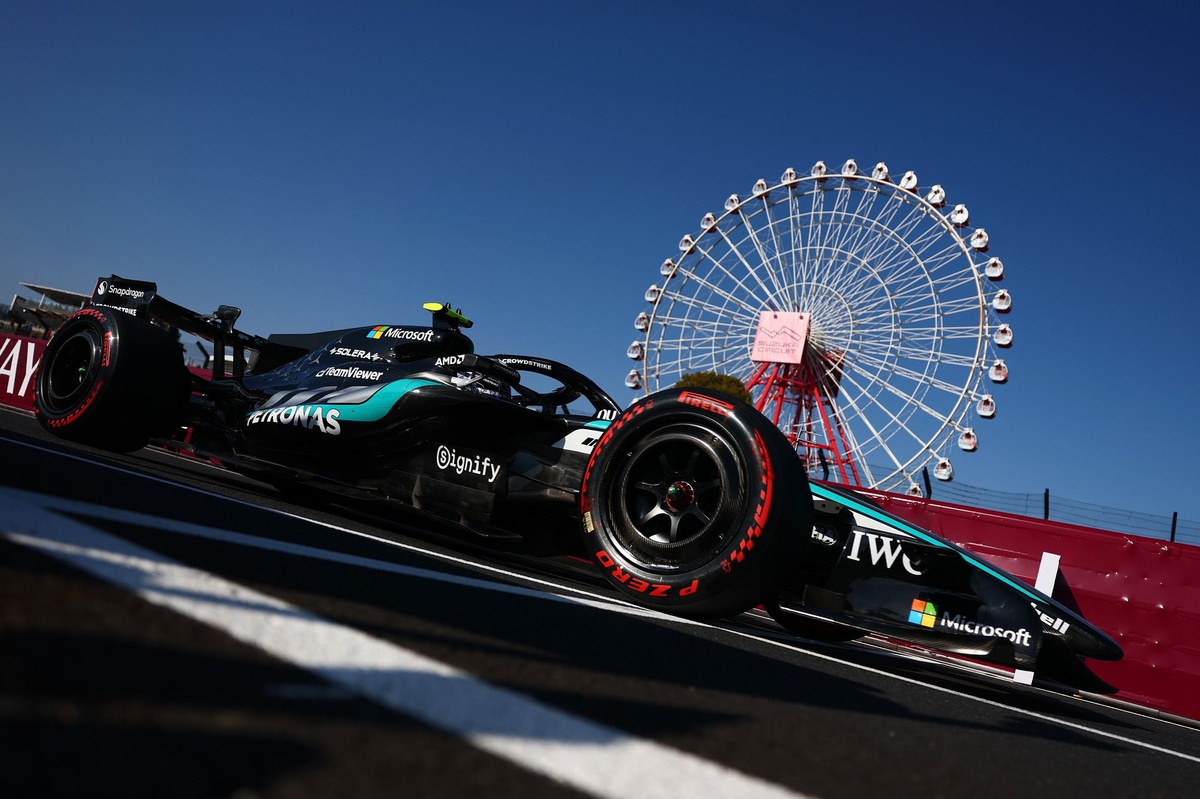
This Friday, during the second free practice session of the Japanese Grand Prix, McLaren driver Oscar Piastri set the best time with a record of 1m30.133s. However, the difference with Mercedes drivers Kimi Antonelli and George Russell was only a tenth, which does not provide a clear insight into the true hierarchy of the competition.
Despite the good news for McLaren, the long runs at the end of the session showed a different picture. With a high fuel load, Mercedes demonstrated clear superiority. In the long run data, Antonelli proved to be much faster than Russell, averaging two-tenths of a second per lap ahead of his teammate.
The Strength of Ferrari
In second place, Ferrari remains at a notable distance from Mercedes. Charles Leclerc was approximately 0.66 seconds per lap slower than Mercedes, and his teammate Lewis Hamilton could not find his rhythm, losing an average of 1.3s per lap. Hamilton also faced issues with tire degradation, further complicating his session.
For his part, Piastri was not far behind, losing 0.96s per lap compared to Mercedes. His teammate, Lando Norris, was unable to complete a long run due to technical problems, spending too much time in the pits.
Where is Mercedes’ Speed?
Regarding qualifying speed, it is clear that Mercedes has not tapped into its full potential. Their best times are particularly situated in sectors one and three, where they achieve significantly higher maximum speeds, especially on the straight leading into turn 1 and the chicane at the end. The speed difference can reach up to 15 km/h on the first straight and about 10 km/h in the third sector.
The pattern is similar for McLaren, which also loses time on the straights but shows more weakness in the corners, creating a key gap with Ferrari.
Red Bull’s Situation
The outlook for Red Bull is concerning. Their drivers, led by Max Verstappen, are 1.49s off Mercedes’ average and even trailing behind Haas and Alpine. Telemetry data indicates that Red Bull performs better on the straights but experiences significant difficulties in corners, especially in the fast ones.
Their sister team, Racing Bulls, is struggling with similar issues, losing excessive time on the straights and giving the impression that the car’s setup may be too aggressive in terms of aerodynamic load.
Competitiveness in the Midfield
In the midfield group, Haas and Alpine emerge with the best performance, with Audi very close. Nico Hulkenberg started his long run well, but his good initial phase was followed by serious difficulties with tire degradation.
Teams like Racing Bulls and Williams continue to show poor performance, with lap times placing them far from the competition and no signs of imminent improvement.
Written by FormulaRapidaAI