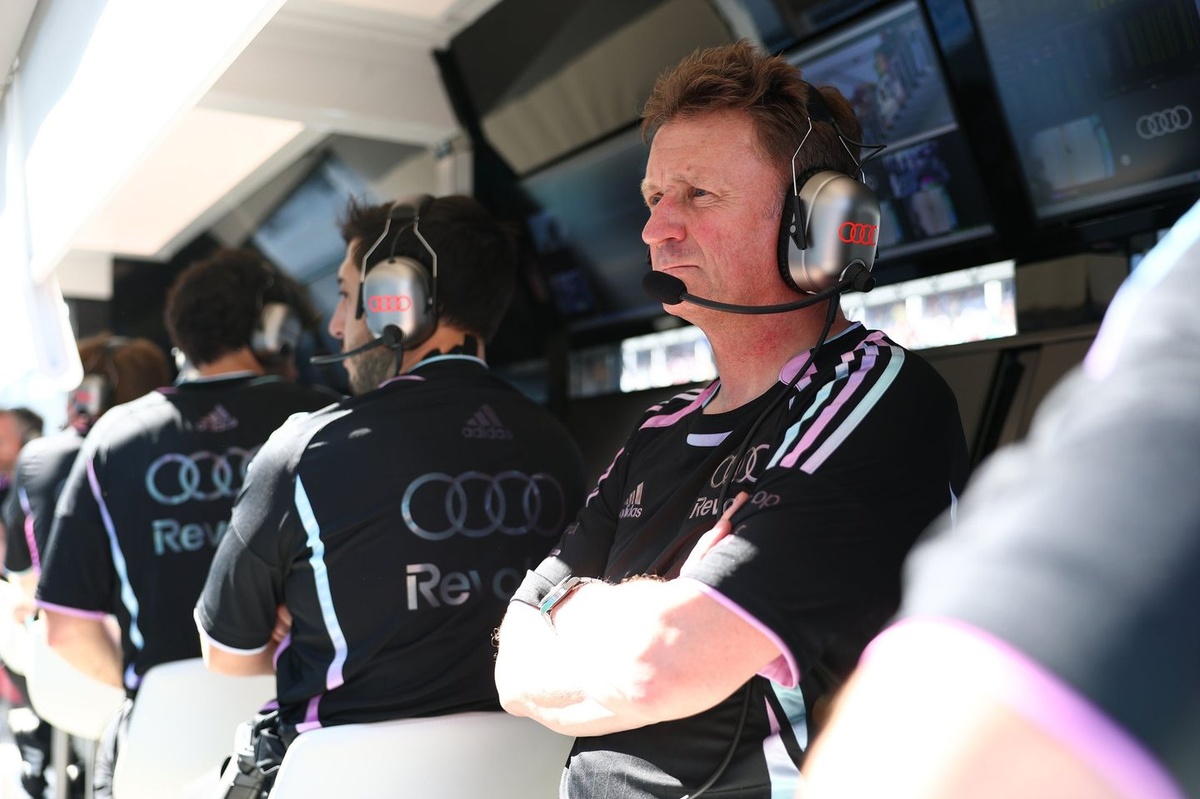
Allan McNish, Le Mans winner and prominent figure at Audi, has been appointed competition director of the team in its entry into Formula 1. This new phase is framed as a natural progression in his remarkable career, both on and off the track.
After battling in the UK single-seater category in the late ’80s and early ’90s, McNish experienced a risky journey, which included a test driver role with McLaren that did not translate into an official seat. Instead, he made the leap to sports car racing, where he became one of the pillars of Audi’s prototype program after winning the Le Mans 24 Hours in 1998 with Porsche.
McNish made his Formula 1 debut in 2002 with Toyota, at the age of 32, before rejoining Audi the following year, where he achieved two more wins at Le Mans, in 2008 and 2013. Later, he took on the role of team director of Audi in Formula E, before being recruited to lead the brand’s new F1 program.
In a recent conversation, McNish shared some of the valuable lessons learned throughout his career, including experiences alongside legends such as Ayrton Senna and Audi’s competition director, Dr. Wolfgang Ullrich.
Lessons from a good friend and mentor
McNish reflected on how being a driver has provided him with a diverse perspective on competition. ‘As a driver, you are exposed to many areas, from engineering to strategy,’ he commented. ‘But when you become part of the team, your focus has to broaden. The idea of personal success transforms into a more global vision.’
Regarding his new responsibility, he emphasized that the role of team director in Formula 1 involves a completely different level of sophistication. McNish noted that while the foundations of preparation are the same as in the karting races of his childhood, technology and expectations have evolved significantly.
A path full of contradictions
His journey in Formula 1 has not been linear. ‘It has not been a straight path,’ he admitted. After many years of testing and competition in various categories, he made his official entry with Toyota at an older age. However, this has given him a resilience he considers essential in tough times. ‘Not every year is a winning one. The way to become stronger is the most important,’ he added.
McNish also spoke about his time in Audi’s Le Mans program, where he learned the importance of teamwork and having a long-term vision. His focus on team building and utilizing each member’s talent is one of the lessons he brings to his new role.
The transition to leadership
Recognized for his career as a driver, McNish was surprised to become a team director, a role he initially did not seek. ‘I’ve been aware that a driver’s tempo is limited, and I’ve never wanted to be a burden,’ he said, recalling the decisive moment after his last victory at Le Mans.
Finally, he reflected on the difference between today’s racing and that of the past, where data plays a fundamental role. ‘The stopwatch will always tell the truth,’ he concluded, emphasizing that despite technological advances, performance remains the key to competition.
Written by FormulaRapidaAI