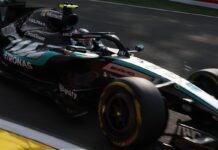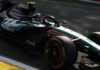
The retirement of George Russell during the Belgian Grand Prix has revealed unprecedented aspects of the floor design of the Mercedes single-seater, highlighting the importance of this critical part for generating aerodynamic load.
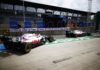
In moments like this, the last thing a Formula 1 aerodynamicist wants to see is their car hanging from a crane, as besides the driver’s inability to continue the session, secrets of the vehicle end up being revealed. Teams keep their floor designs secret, as the principle of aerodynamic load comes, to a large extent, from this area.
Details of Mercedes’ floor
The view of the floor of Russell’s Mercedes unit at Spa-Francorchamps has provided valuable information about the construction of the pieces that occupy the high positions on the grid. Observing the details, multiple components can be identified, such as the diffuser, responsible for expanding the airflow and creating a low-pressure area behind the car.
Moreover, the anti-scrape plastic is a crucial element to ensure that cars do not run too low. If it wears down more than 1 mm during a race, it can be considered grounds for disqualification. Adjustments in the design of the diffuser and other aerodynamic components are evident, proving essential to maximize the car’s efficiency.
Impact of the new rules
With the introduction of the new rules, the floor design has achieved more flexibility. This year, many teams have experimented with a diffuser having a ‘hole’ that allows for better expansion of airflow. This innovation helps to effectively manage airflow and improve the diffuser’s efficiency, which can be key for the stability of the rear axle.
The mosaic of aerodynamic adjustments, including changes in the design of the suspension and the rear wing, adjusted to the diffuser, seeks greater load, directly impacting on-track performance. As the competition progresses, observing how teams take advantage of these opportunities to improve the efficiency of their vehicles will be fascinating.
Written by FormulaRapidaAI