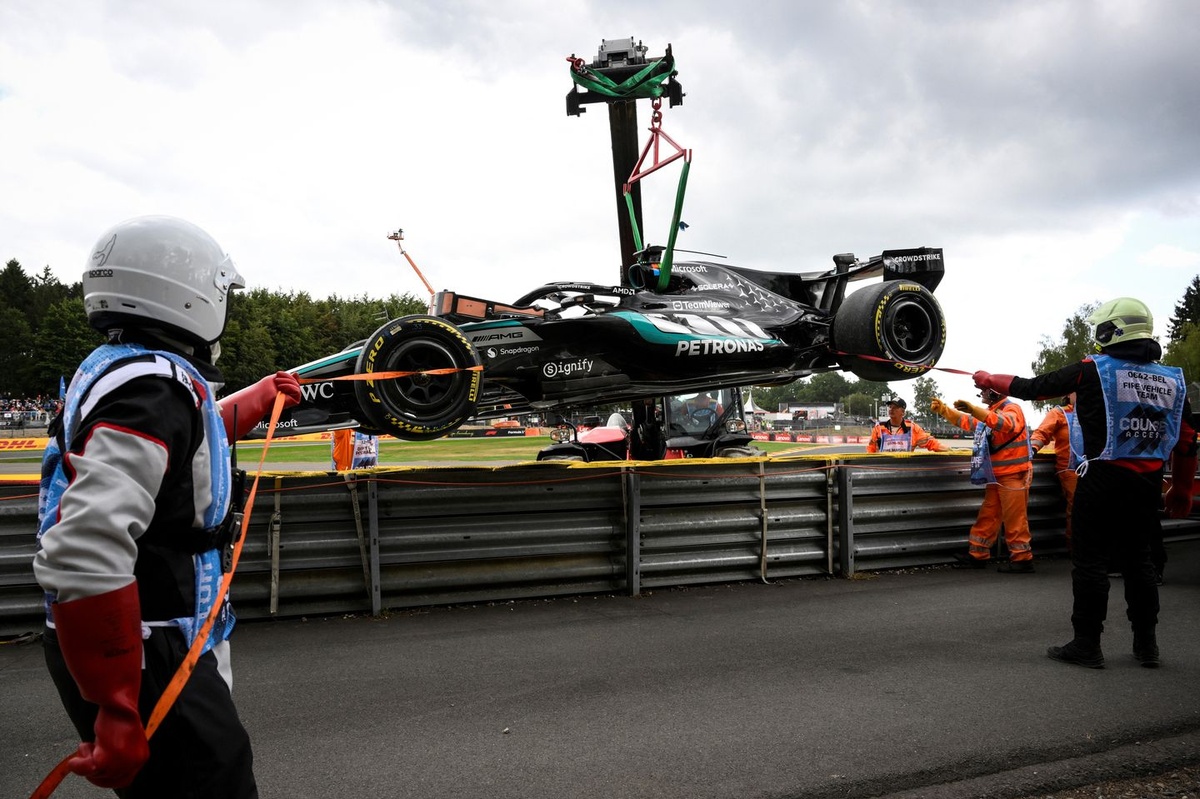
The recent retirement of George Russell during the Belgian Grand Prix has highlighted some of the most intriguing aspects of the floor design of the Mercedes Formula 1 car, leaders of the championship. The incident, which required the intervention of a tow truck to remove the vehicle from the gravel, has allowed for an unusual view of the aerodynamic architecture of the unit.
In the world of Formula 1, the floor design is one of the best-kept parts of the vehicles, as it is responsible for generating a large part of the aerodynamic load. In situations like this, where the car is lifted, details that typically remain hidden are exposed for other teams to see, who can analyze and learn from them.
The race navigator, Sergio Pérez, experienced a similar situation in his qualifying accident in Monaco, which helped other teams better understand the performance of his car. Now, visualizing Russell’s car floor can offer clues about how the aerodynamic load of this year’s Mercedes has been optimized.
Details of the Mercedes floor design
Some key components of the floor design that have attracted attention include:
- Diffuser: facilitates the expansion of airflow, creating a low-pressure zone behind the car.
- Diffuser rise line: marks a transition at the lower parts of the floor.
- Deceleration plate: made of resin and designed to ensure that vehicles do not go too low.
- External floor thickness: regulated by the FIA to contain the aerodynamic load.
- External diffuser components: connect the aerodynamics of the wheels to the diffuser.
These elements work together not only to generate force at the rear but also to ensure the stability of the car. As the diffuser directly affects the behavior of the vehicle, any variation in its design can influence the driver’s confidence.
With the implementation of the new rules, adaptations to the diffuser design are more flexible, allowing teams to experiment. This has been seen with the innovations introduced, such as the small holes at the bottom of the diffuser that help manage airflow.
As teams face complex maneuvers, the ability to maintain adequate airflow is crucial. Mercedes has made adjustments in this area, as seen in the Canadian Grand Prix, to improve vehicle response to tire ‘squirt’ situations.
The sooner aerodynamic techniques are perfected, the greater the driver’s confidence will be in controlling the vehicle, which is essential for competition. The visibility of Russell’s floor has provided a unique opportunity to learn from the technology that drives Mercedes’ success on the track.
Written by FormulaRapidaAI