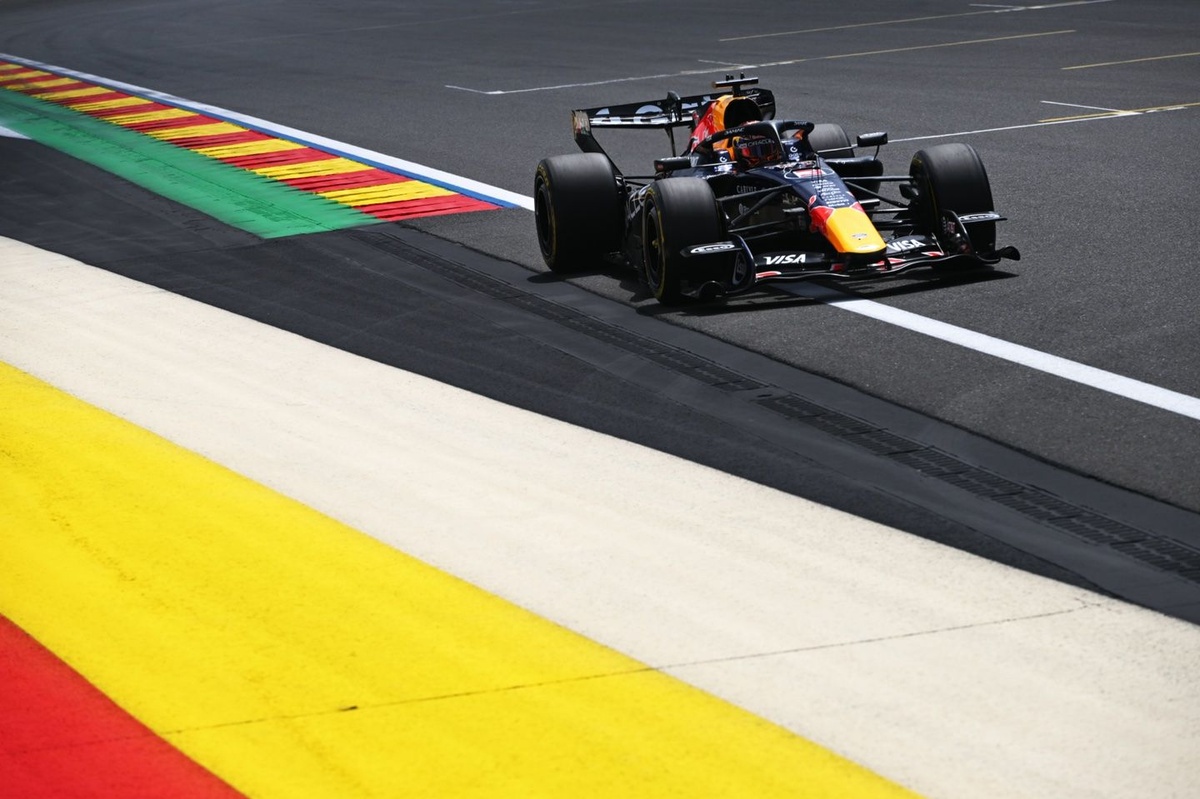
Max Verstappen set the pace in the first practice session of the Belgian GP, recording the best time with a lap of 1m47.070s, just a few hundredths ahead of Lewis Hamilton from Ferrari. The Red Bull driver demonstrated good initial speed at the Spa-Francorchamps circuit.
During the first twenty minutes, Red Bull drivers Verstappen and Hadjar exchanged record times. Verstappen, on medium tires, was the first to dip below 1m47s, posting a time of 1m47.859s in the first 10 minutes. The competition between both drivers continued, with Hadjar slightly improving on his next lap.
As time passed, the Red Bulls remained at the top of the time sheet and, halfway through the session, Antonelli managed a 1m47.603s that briefly put him in the lead, but Hadjar closed the first half hour with a time of 1m47.322s, regaining the leadership.
Shortly after, Verstappen made a new effort with soft tires, achieving the best time of the session that allowed him to pull away from his teammate as well as the rest of the competitors. Ferrari managed to split the two Red Bulls, with Hamilton just 0.145s behind Verstappen and Leclerc half a second behind his teammate.
Despite his rivals’ efforts, Verstappen maintained his lead with a time that, although excellent, was five seconds off Piastri’s mark in 2025.
Oscar Piastri was fifth fastest, 0.452s off Verstappen’s time, with his teammate Kimi Antonelli close behind. In the final minutes of the session, the McLaren driver faced some mechanical issues but managed to return to the pit with sufficient hydraulic pressure.
Lando Norris and George Russell completed the top eight, while Arvid Lindblad from Racing Bulls was the first driver outside the second in the time sheet, testing a new design for the roll-hoop intake. Gabriel Bortoleto rounded out the top ten, with a time slightly better than Liam Lawson.
The session highlighted Aston Martin’s difficulties, with Lance Stroll 5.7s off the best time, indicating that the team will need to work hard to improve over the weekend.
Written by FormulaRapidaAI