
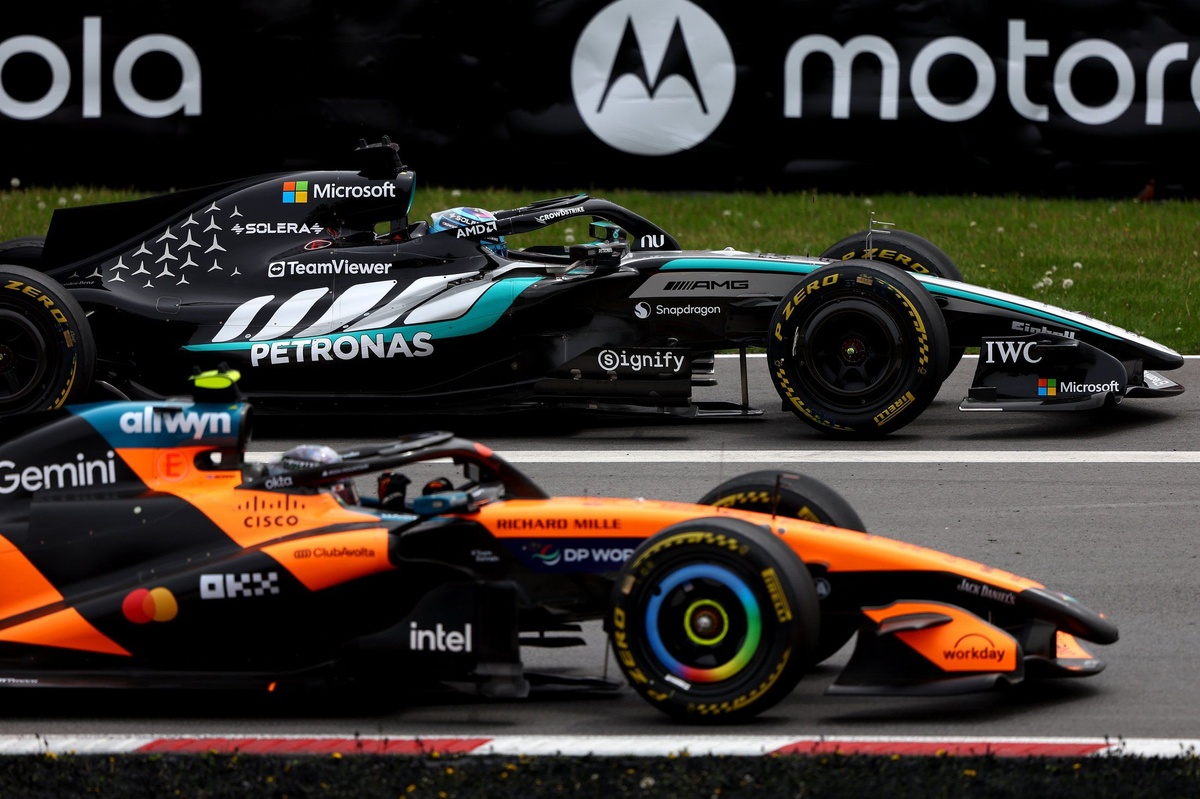
Gearboxes have regained relevance in Formula 1 as teams adjust their designs to comply with the new regulations of 2026. At the epicenter of this debate is the comparison between Mercedes and McLaren, which, despite sharing the same engine, employ different shifting strategies that influence their on-track performance.
McLaren has chosen to design and manufacture its own gearbox, opting for a shorter gear ratio in the MCL40. This allows them to achieve better starts and initial acceleration. The team principal, Andrea Stella, commented on this during the Canadian Grand Prix: “We are on the shorter side compared to Mercedes, which can give us advantages in acceleration and on the starts.”
After the first races of the season, it has been shown that McLaren often has stronger launches than Mercedes, suggesting that the difficulties of the latter cannot be attributed to a single factor. Just as the size of the turbocharger can increase or decrease performance, gearbox ratios also have advantages and disadvantages.
Mercedes and Red Bull have opted for longer gear ratios, which help maintain higher engine revs in slow corners, maximizing battery recharge. McLaren’s shorter gears, on the other hand, multiply the torque at the wheels, improving their acceleration, especially before the MGU-K comes into action.
The difference in gear ratios has not been limited to just starts. Data from the early grands prix reveal that McLaren is more competitive on circuits with shorter sections. In Miami and Montreal, for example, energy strategies and recovery limits added context to the performance differences between the two units.
In races like the one in Montreal, where the limit was 6 MJ per lap, McLaren had to carefully manage its energy. On the first straight in Miami, they performed well, but as the straight extended, their MCL40 suffered. Additionally, strategic decisions like modifying battery management affected their final speed, which was surpassed by Mercedes.
Looking at the gearbox layouts, it can be observed that McLaren often uses a higher gear at different points on the track. This choice can offer benefits not only in lap time but also in energy recovery opportunities, particularly on circuits with long straights.
Stella emphasized that each approach has its strengths and weaknesses depending on the type of circuit. On tracks with long straights, Mercedes has extra potential, while McLaren can leverage its acceleration capability on more twisty circuits.
Gear ratios must be homologated at the beginning of the season; however, for this year, there is an exception that allows teams to modify them only once. Stella mentioned that they currently do not consider this option, as they believe their current system is adequate and that the advantages outweigh the disadvantages.
Written by FormulaRapidaAI