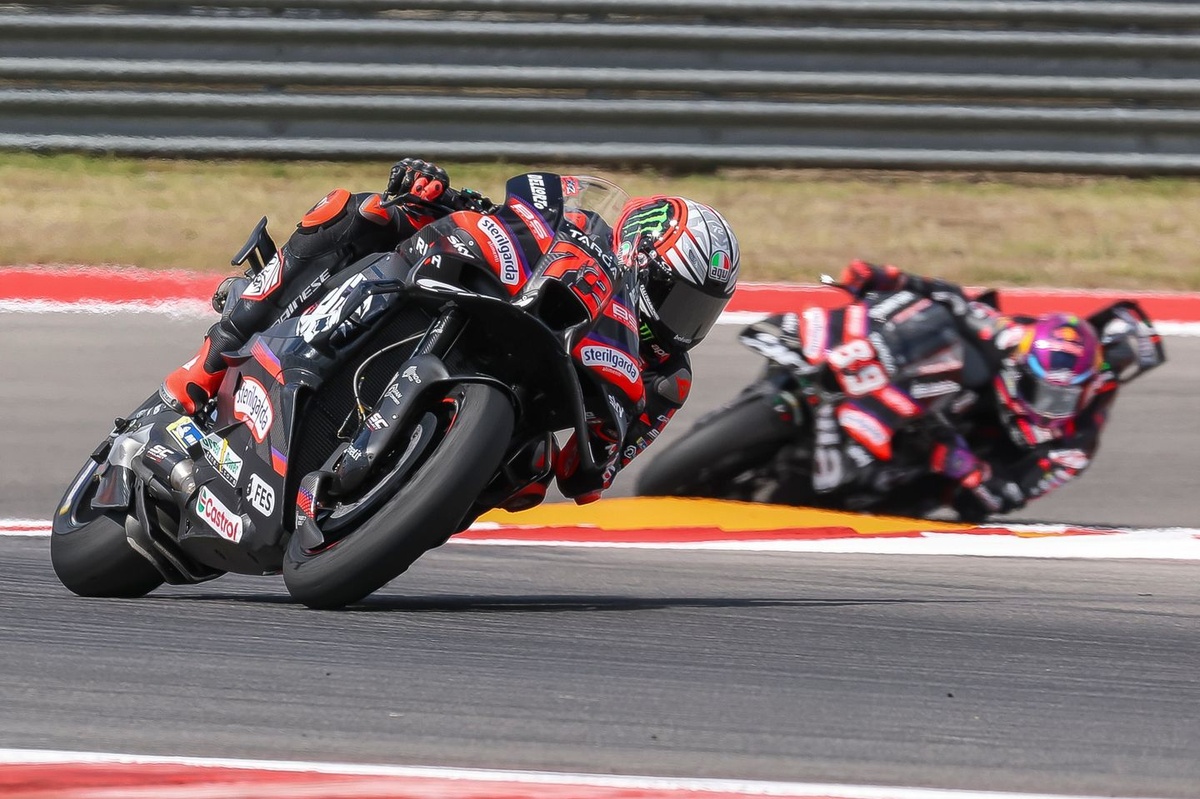
The next MotoGP season is expected to be a major shift for all manufacturers, with new regulations that will redefine the competition. The new regulations will include 850 cc engines, a reduction in aerodynamic features, and the elimination of height control devices, along with a significant change in the tire supplier, with Pirelli replacing Michelin.
All manufacturers have begun working on prototypes for this new era. Thus, KTM conducted the first tests of its 2027 bike in Jerez at the end of last year, while Honda and Yamaha were testing in Sepang and Japan respectively, with test riders. Recently, KTM and Yamaha returned to Jerez in March to continue their development, now with Pirelli tires.
Tests in Italy
During April, the Italian manufacturers, Aprilia and Ducati, will present for the first time their prototypes for 2027. The test riders, Lorenzo Savadori and Nicolo Bulega, will be responsible for these initial outings. Other testing sessions are scheduled to take place in Mugello in May, followed by Barcelona and Misano in mid-May, focusing on the 850 cc bikes and Pirelli tires.
Incorporation of regular riders
Permanent MotoGP riders will not be able to test the 2027 bikes until June 22, the Monday after the Czech Republic Grand Prix. Additional tests for the 850 cc bikes will then be scheduled in Spielberg (after the Austrian GP) and Valencia (after the end of the season on November 29).
The tests in Brno and Spielberg will be crucial for development, as manufacturers will rely on feedback from their racing riders to obtain more accurate insights. However, the increasingly active rider market for 2027 will complicate the process, as only those riders who already have active contracts or have renewed with their current manufacturer will be able to test the new bikes.
Who will and who will not be able to test?
Only those riders who have secured extensions with their current manufacturers before the tests in Brno and Spielberg will be able to ride the 2027 prototypes. This includes figures like Marc Márquez at Ducati and Marco Bezzecchi at Aprilia. Manufacturers will not allow riders to test machines from competing brands, which rules out scenarios such as Fabio Quartararo testing a Honda or Pedro Acosta a Ducati.
Currently, only a limited number of riders, estimated at seven, are expected to test the 850 cc prototypes during the scheduled sessions in the Czech Republic and Austria. Other riders are ineligible, and the status of many more is uncertain.
End of concessions and testing in Valencia
Once the season concludes in Valencia on November 29, attention will shift to when the current concessions framework will formally end. The main question is whether this will happen immediately after the competition ends or only at the end of the year, on December 31.
The most likely scenario is that the restrictions will be lifted immediately after the Valencia Grand Prix. If so, all riders will be free to test for their future manufacturers in the post-season tests, regardless of whether their contracts formally expire at the end of the year.
This will make Valencia a crucial moment in the development of the 2027 bikes, allowing manufacturers to gather feedback from their riders before the first pre-season test at the end of January.
Written by FormulaRapidaAI